نظريه اي در " توسعه فركتال بر معماري " و نظریه آشفتگی و شهر و ...
نظريه اي در " توسعه فركتال بر معماري " و نظریه آشفتگی و شهر و ...
مقدمه
بيش از دو دهه است كه رابطه اي پيچيده و متناقض بين معماري و علوم پيچيده وجود داشته است . گر چهاز آن زمان اصل اينرابطه تغيير يافته ، اما نقطه اتصالي به نام هندسه فركتال بين آنها وجود دارد . هم معماران و هم رياضي دانان ، هر كدام حول اين موضوع كه چه چيزي ممكن است يا ممكن نيست هندسه فركتال را به وجود آورده و تعاريفي ارايه داده اند كه به طرز ناباورانهاي شباهت هاي كمي بين تعاريف آنها از معماري فركتال وجود دارد . از طرفي هر كدام از تعاريف نيز علامت تشخيص منحصر به فردي ندارد . گروه بزرگي از معماران با تجربه ، عقايد رياضيدانان را درباره ساخت محيط پيراموني رد كردهاند ! ولي برخلاف آنان ، رياضيدانان مشغول شناسايي تاريخ طولاني استفاده معماران از هندسه فركتال در طراحيهاي شان هستند .
هدف اين تحقيق تهيه يك تعريف قابل قبول هم براي معماران و هم براي رياضي دانان زمان پيشرفت و سقوط معماري فركتال در اواخر قرن بيستم است .
اين پروژه ، سه شرط يا سه قانون مشخص دارد كه وسعت آن را تعيين مي كند . اولاً ، از اعتبار هيچ ادعاي خاصي نه از جانب معماران و نه از جانب رياضيدانان سوال نمي كند گرچه مداركي وجود دارد كه بتوان گفت ادعاهاي هر دو طرف قابل بحث است . ثانياً ، اين پروژه فقط مربوط به تلاش هاي هوشيارانه و آگاهانه اي است كه با استفاده از هندسه فركتال سعي در ايجاد معماري دارند . تعدادي از نمونه هاي برجسته ساختمان هاي تاريخي كه اشكال فركتال را به نمايش گذاشته اند و از سوي هر دو گروه معماران و رياضي دانان پيشنهاد شده اند . به عنوان اهداف اين پروژه مي توان ساختمانهاي فركتالي از قبيل كاخ هاي مختلف قرون وسطايي ، كليساهاي ناموزون و بي تناسب قرن هجدهم ، معبدهاي هندويي و آثار فرانك لويد رايت يا لوييس ساليوان را نام برد كه حتي اگر داراي يك مشخصه مستقيم و ملموس از هندسه فركتال باشند ، باز هم نمي توان آنها را جزو آثاري به حساب آورد كه صرفاً فركتالي و تنها به همين هدف ساخته شده باشند . به همين دليل پايه هاي معماري فركتال ( صرفاً به منظور فركتال ) تا بعد از هندسه فركتال كه توسط بنوت مندل بروت دراواخر سال 1970 شكل گرفت ، نمي تواند وجود داشته باشد . هر چند جرج سنتر ، ژوزف پيانو ، ديويد هيلبرت ، هلگ ون كك و كلاو سرپينسكي ، گستن جوليا و فليكس هازدرف مطالعاتي روي پروژه هاي بسيار عظيمي كه در هندسه فركتال پيش رو هستند ، انجام داده اند ولي همگي نادرست و غير اصولي و ميتوان گفت بيشتر متمايل به رياضي اند تا معماري , و در نهايت ، اين تحقيق مربوط به روابط بين هندسه فركتال و علوم پيچيده است . در حالي كه رياضي دانان و دانشجويان ، به هندسه فركتال در جاي خودش اهميت مي دهند ، معماران عموماً به خاطر رابطه آن با تئوري و تئوري كاوس يا نظريه آشوب و علوم پيچيده بيشتر به آن اهميت مي دهند . به اين دليل كه اين معماران معاصر هم مانند معماران تاريخي ، به هندسه و رياضيات علاقه چنداني ندارند . اما در واقع ارزش هندسه به خاطر توانايي آن براي ايجاد يك رابطه رمزي و مجازي با چيزهاي ديگر است . بنابراين براي معماران مدرن ، هندسه فركتال علاوه بر شناسايي نمونه جهاني كه از ديدگاه نيوتن و پاپلاس فاصله گرفته ، رابطه خوبي با طبيعت يا جهان برقرار كرده است . به اين دليل در اين پروژه ، اكثريت وسيعي از معماران ، هندسه فركتال را بخش كامل يا نشانه اي از تئوري كاوس و علم پيچيدگي قلمداد مي كنند .
نظریه آشفتگی
ادوارد لارنز استاد علوم هواشناسی در دانشگاه M .I .T در آمریکا آشفتگی را
در دههء 70 میلادی مطرح کرد. واژه آشوب در بسياري از مقالات معماري كه
در سالهاي اخير به چاپ رسيده است به چشم مي خورد. قبل از آنكه ادلورنز
نظريه آشوب را طرح كند، انديشمندان تمامي پديده هاي جهان را تصادفي يا جبري مي پنداشتند، اما لورنز نظريه اي را مطرح كرد كه به تبع آن، برخي از پديده هاي جهان و چه بسا بسياري از آنها، ظاهري تصادفي داشته اما در واقع تابع قواعد بسيار پيچيده اي هستند.ماجرا از اين قرار است كه يك روز ادلورنز، هواشناس آمريكايي، پس از چند دقيقه استراحت كاري متوجه پديده شگفت آوري در رايانه خود شد. اين اتقاق در سال 1961 افتاد. در آن زمان لورنز در موسسه فن آوري ماساچوست كار مي كرد.
كار او تحقيقاتي در زمينه الگوهاي جو زمين بود. سالها بود كه هواشناسان روياي پيشگويي وضعيت آب و هوا را در سر داشتند، اما پيچيدگي قواعد حاكم بر جو زمين مانع اين امر بود.
از جمله اين پيچيدگي ها، كميت هايي نظير دما و سرعت بالا بود كه رابطه آنها با يكديگر بسيار پيچيده و تابع معادلاتي غير قابل پيش بيني بود. از آن جايي كه هيچگونه ارتباط مستقيم و ساده اي مابين اين كميت ها وجود ندارد، رياضيدان ها آنها را معاملات غيرخطي ناميده اند. به عنوان مثال افزايش 10درصدي دماي هوا لزوما باعث افزايش سرعت باد به همين ميزان نخواهد شد.
لورنز براي حل اين مسئله؛ يعني پيش بيني وضعيت آب و هوا، از يك رايانه استفاده مي كرد. با وجود اينكه رايانه او قادر به ارائه راه حل كلي براي اين
منظور نبود، اما دست كم اين امكان را براي او مهيا مي كرد كه در موارد خاص به بررسي نحوه رفتار آنها بپردازد. او علاقه زيادي به بررسي جريان هاي همرفت داشت و پس از برنامه نويسي براي معادلاتي كه به شرح پديده همرفت مي پرداختند، موفق شد يك منحني به كمك رايانه ترسيم كند. اما رايانه تنها مي توانست در هر ثانيه 60 عمل ضرب را انجام دهد. بنابراين او تصميم گرفت اين سرعت را افزايش دهد و به جاي اينكه هر بار فعاليت رايانه را از صفر آغاز كند، از مراحل مياني كاركرد قبلي را به رايانه داد سپس آن را به حال خود رها كرد و براي صرف قهوه به استراحت پرداخت.
زماني كه براي بررسي نتيجه كار بازگشت با پديده شگفت انگيزي روبه رو شد. او توقع داشت رايانه قبل از اتمام كار، تنها به تكرار نيمه دوم عملكرد قبلي بپردازد، اما ديد كه رايانه از گزارش عملكرد خود امتناع مي كند. آغاز كار به
همان صورت قبل بود، اما در ادامه مسير ديگري را پيموده بود.
لورنز كه اين بار اعداد را تا حدود ناچيزي گرد كرده بود، مشاهده كرد كه اين
تغييرات كوچك منجر به تغييرات اساسي شده است. به اين ترتيب او بر حسب
اتفاق به كشف بزرگي نائل شد و آن را به اين ترتيب نوشت: زماني كه با
پديده هاي غيرخطي نظير شرايط جوي سرو كار داريم، تغييرات ناچيز ممكن است به نتايج عظيمي منجر شوند. لورنز اين پديده شگفت انگيز را تحت عنوان اثر پروانه جاودانه ساخت.
امروز دانشمندان اين نظريه را در انواع ديگري از پديده ها كه اثرات غير خطي دارند، بسط داده اند. حتي موقعيت ستارگان كه زماني به عنوان نمونه اي از پديده هاي قابل پيش بيني محسوب مي شدند اكنون تا حدود زيادي جز و پديده آشوب به حساب مي آيند و تمامي آنها در مقابل تغييرات كوچك حساسيت نشان
مي دهند و با تبديل رفتار آنها به حالتي تصادفي، وضعيتي غيرقابل پيش بيني پيدا مي كنند. با اين حال اين پديده ها در واقع تصادفي نيستند، بلكه قوانين حاكم بر آنها به حدي پيچيده است كه شباهت زيادي به تصادف دارند.
آشوب عنواني ست كه جيمز بورك، رياضيدان آمريكايي در سال 1975 بر اين حالت نهاد و آن را پديده اي بينابين نظم و تصادف محض دانست. اينكه يك پديده ظاهرا تصادفي را چه هنگام مي توان آشوب دانست مسئله مهمي است. دانشمندان در تشخيص حضور آشوب و شدت آن، راه هايي را يافته اند كه تا اندازه زيادي دامنه پيش بيني هاي آن را پوشش مي دهد. در يك رويداد واقعا تصادفي مثل قرعه كشي، هيچ ارتباطي بين پارامترها وجود ندارد، اگر در هر پنچ بار قرعه كشي پي در پي عدد 17 بيايد، احتمال بيرون آمدن عدد 17 در قرعه كشي بعدي نه كمتر و نه بيشتر است. هيچ راهي براي پيش بيني در چنين وضعيتي وجود ندارد. در اينگونه حوادث هيچ رابطه منطقي بين گذشته و آينده وجود ندارد. در مقابل، سيستم هاي منظمي نظير ساعت بلور كوارتز وجود دارند كه تا آينده اي دورقابل پيش بيني هستند.
تلاش هاي زيادي براي يافتن پديده آشوب در مدارك اقتصادي كه ظاهري تصادفي دارند نيز انجام شده است. رفتار تصادفي قابل بررسي در اموري نظير توليد ناخالص ملي يا نرخ تبادل ارز وجود دارد كه به صورت بالقوه قابل پيش بيني ست. به طور كلي پژوهشگران در حال بررسي پديده آشوب در حوزه هاي مختلفي از علم هستند و اين امر تبديل به يك حالت عمومي شده است.
اما تاثير آن در هنر و معماري نه به شكل علمي آن بلكه به عنوان يك روش طراحي بوده است. عده اي از هنرمندان اين روش را در طراحي به اين ترتيب به كار مي گيرند كه اطلاعاتي را به رايانه داده و امر طراحي را به خود رايانه واگذار مي كنند. اتفاقي كه مي افتد روشي شبيه به پديده هاي موجود در طبيعت است. در واقع اين روش طراحي الگوي خود را از پديده هاي مشابه در طبيعت كه طبق قاعده آشوب عمل مي كنند اقتباس كرده است. هنرمندان از همان دهه 60 آثاري را خلق كردند كه ظاهري تصادفي داشته باشد، اما تابع قواعد بسيار پيچيده اي هستند كه حتي ممكن است خود هنرمند نيز آگاهي كاملي از آن نداشته باشد.
لورنز در سال 1972 مقاله ای بنام (آیا حرکت بال پروانه دربرزیل باعث بوجود آمدن گردبادهای عظیم در تگزاس می شود؟) نوشت که این مقاله بنام اثر پروانه شهرت یافت.براساس این نظریه اتفاقات کوچک موجب رخ دادن اتفافات بزرگ می شود. به نظر لارنز به دلیل وجود آشفتگی تغییرات آب و هوایی را نمی توان پیش بینی کرد و همیشه این پیش بینی ها تقریبی است.
از این زمان به بعد به تدریج ریاضی آشفتگی و علم آشفتگی مطرح شد. ریاضی آشفتگی توسط بنوت مندل بروت ریاضی دان لهستانی تبار مطرح شد.بر اساس نظریهء وی قوانین ساده اشکال پیچیده ایجاد می کنند.
مجموعه مندل بروت پیچیده ترین فرکتال است که تابع یکی ازساده ترین قوانین ریاضی است.قوانین آشفتگی در حد بی نهایت از یک فرمول ساده ریاضی بدست می آیند.
فرکتال
واژه فرکتال مشتق از واژه لاتینی فراکتوس –به معنی سنگی که به شکل نامنظم
شکسته و خرد شده است- در سال 1975 اولین بار توسط بنوت مندل بروت
مطرح شد. برخالها (فرکتال، فراکتال fractals)، ساختارهایی اند که خود را
در مقیاس کوچکتر تکرار میکنند. واژه برخال از دو پاره برَخ و ال ساخته شده
است.
برخ واژه فارسی برای کسر (fraction) است و پسوند ال پسوندی به معنای،
مرتبط با، است (مانند چنگال: مرتبط یا همشکل با چنگ پوشالم وط به پوشاندن،
سَنگال و جز اینها).
نشان دادن این ساختارها در قالب نگارین (گرافیکی) گاه اشکال نامنظم، نغز و
پیچیدهای را با فرمولهای سادهی ریاضی تولید میکند. برخالها از سال ۱۹۸۰
به بعد مورد نگرش واقع شده و هندسه نوینی به نام هندسه برخالی را پدید
آوردهاند فرکتالها شکلهایی هستند که بر خلاف شکل های هندسه اقلیدسی به هیچ
وجه منظم نیستند. این شکلها اولا سرتاسر نا منظم اند, ثانیا میزان بی نظمی آنها
در همه مقیاسها یکسان است.
با ملاحظه اشکال موجود در طبیعت مشخص می شود که هندسهء اقلیدسی قادر به تبیین و تشریح اشکال پیچیده و ظاهرا بی نظم طبیعی نیست.
میزان بی نظمی در همه مقیاسها یکسان است.
مندل بروت در سال 1975 اعلام کرد که ابرها به صورت کره نیستند, کوهها همانند مخروط نمی باشند, سواحل دریا دایره شکل نیستند , پوست درختان صاف نیست وصاعفه به صورت خط منظم حرکت نمی کند. جسم فرکتال از دور و نزدیک یکسان دیده می شود به تعبیر دیگر خود متشابه است. وقتی به یک جسم فرکتال نزدیک می شویم میبینیم تکه های کوچکی از آن که از دور هچون دانه های بی شکلی به نظر می رسید , به صورت شکل مشخصی در می آید که شکلش کم و بیش همان شکلی است که از دور دیده میشود.
در طبیعت نمونه های فراوانی از فرکتالها دیده می شود. درختان, کوهها, رودها, لبه سواحل دریا, سرخس ها, گل کلم ها اجسام فرکتال هستند. بخش کوچکی از درخت که شاخه باشد شباهت به کل درخت دارد. این مثال را می توان در مورد ابرها, گل کلم ها, صاعقه وسایر اجسام فرکتال عنوان نمود.
كوهها نمونه هايي از فركتال هاي طبيعي
نمونه اي از گسترش شهرها به صورت فركتال
نمونه هايي از ساخته هاي فركتالي انسان
بسیاری از عناصر مصنوع دست بشر نیز به صورت فرکتال می باشند. تراشههای سیلیکان, منحنی نوسانات بازار بورس, رشد وگسترش شهرها, مثلث سرپینسکی و...
ويژگيهاي فركتال
اشكال اقليدسي با استفاده از توابع اشيا و اشكال فركتال با فرآيندهاي پويا توليد ميشوند . فرآيندهاي پويا ، فرآيندهايي هستند كه داراي حافظه ميباشند و رفتار آنها به گذشته بستگي دارد . علاوه بر آن اشياي فركتال داراي خاصيت خود مانندي هستند . طول اين اشياء بينهايت استكه در يك فضاي محدود محصور شدهاند .مجموعههاي فركتال از زيرمجموعههايي تشكيل شده اند كه اين زيرمجموعهها شامل مجموعههاي بزرگتر هستند . مجدداً اين مجموعهها از زيرمجموعههاي كوچكتري تشكيل شدهاند . اين زير مجموعهها نيز شبيه مجموعههاي بزرگتر هستند . چنين ساختارهايي داراي ظرفيت اطلاعاتي زياد هستند در صورتيكه ظرفيت اطلاعاتي اشياء اقليدسي بسيار محدود و شامل اطلاعات تكراري است .
مجموعه هاي فركتال قابليت توصيف رياضي بسياري از اشكال پيچيده و به ظاهر نامنظم در طبيعت را دارند ، به همين جهت مي توان هندسه فركتال را بيان رياضي از معماري طبيعت دانست
مكانيزم توليد اشياء فركتال
سيستم ها را از لحاظ رفتار نهايي و مجموعه حديشان ميتوان به 4 دسته تقسيم بندي نمود :
1. سيستم هايي كه داراي نقطه تعادل هستند . مجموعه حدي اين سيستم ها در فضاي حالت تشكيل يك نقطه را مي دهند .
2. سيستمهاي نوساني ، مجموعه حدي اين سيستم ها در فضاي حالت تشكيل يك منحني بسته را مي دهند .
3. سيستم هاي شبه نوساني ، مجموعه حدي چنين سيستم هايي در يك محدوده حلقوي شكل از فضاي حالت محصور شده و به طور يكنواخت در اين محدوده توزيع شده اند و تشكيل يك چنبره را در فضاي حالت مي دهند .
4. سيستم هاي آشوبگونه : مجموعه حدي اين سيستم ها داراي يك شكل هندسي ساده
5. ( نقطه ، منحني بسته و چنبره ) نيست و تشكيل يك شي فركتال را مي دهند .
مسيرهاي حالت سيستم هاي آشوبگونه در فضاي حالت داراي طول بي نهايت هستند كه در يك فضاي محدود محصور شده اند و اين از اعجاز سيستم هاي آشوبگونه است . با توجه به ويژگي مجموعه حدي سيستم ها در فضاي حالت ، ظرفيت اطلاعاتي سيستم هايي كه داراي نقطه تعادل هستند ، محدود و منحصر به نقاط تعادل مي شود .
هر فرآيند تكراري و پويا باعث ايجاد ساختارهاي پيچيده فركتال نمي شود ، مكانيزم توليد چنين ساختارهايي ، پويايي آشوب است در حقيقت فركتال تصوير رياضي از آشوب است .
دانه برفي Kock
يك مثلث متساوي الاضلاع را با طول L در نظر بگيريد . هر ضلع اين مثلث را به سه قسمت مساوي تقسيم كنيد و قسمتهاي وسط را حذف كنيد . سپس قسمتهاي برداشته شده را با دو پاره خط ، هر يك به طول
مثلث Serpinski
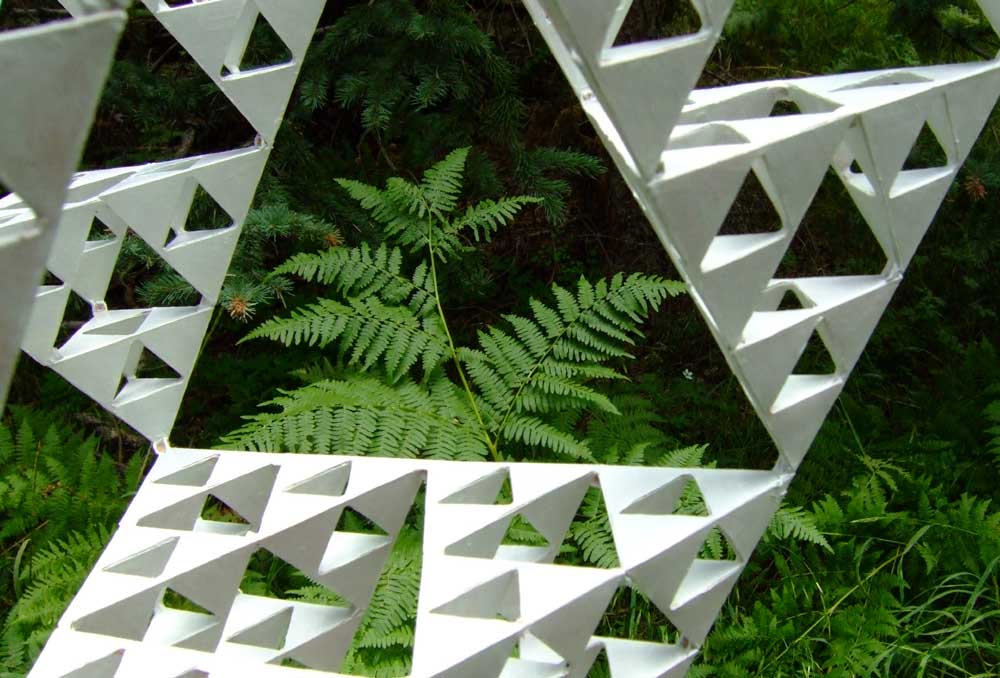
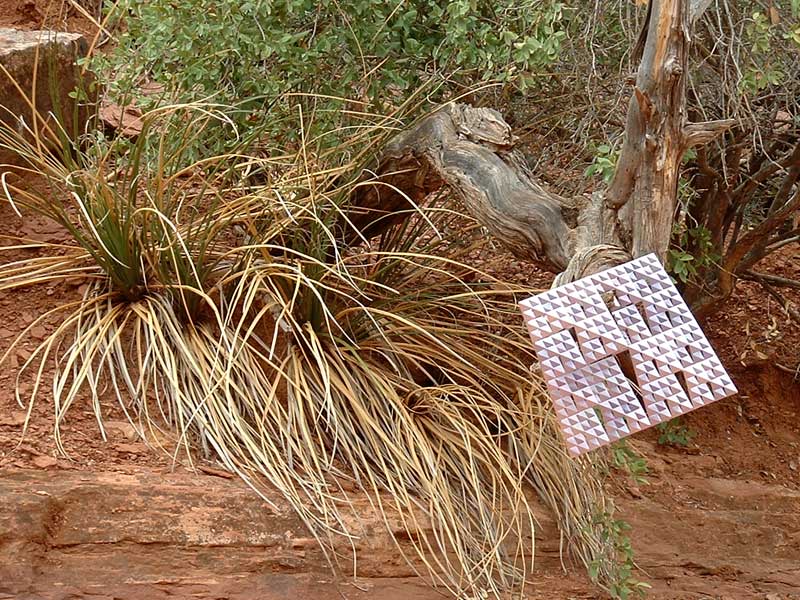
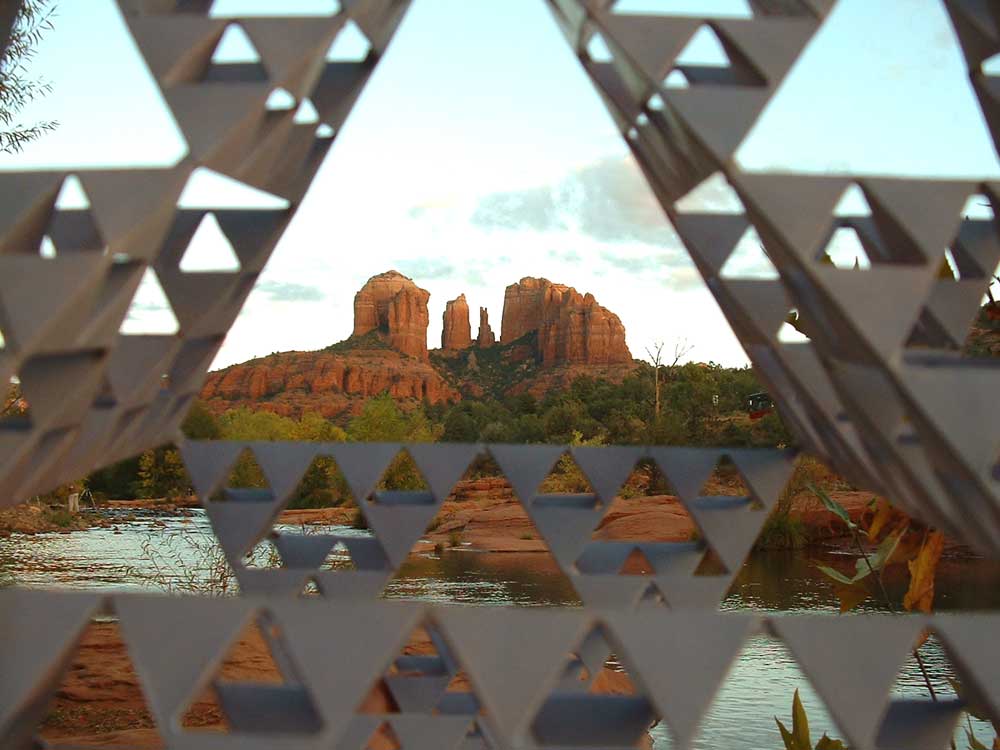
اين مثلث جزء يكي از معروفترين اشياء فركتال مي باشد . اين شي شامل مثلث بزرگي است كه در داخل آن بي نهايت مثلث كوچك وجود دارد . اين مثلث را به سادگي مي توان توليد كرد . يك مثلث متساوي الاضلاع تو پر را در نظر بگيريد چنانچه وسط هر ضلع و مثلث وسط را حذف كنيم و اين فرآيند را براي مثلث هاي باقيمانده تكرار كنيم ، در نهايت شكلي كه حاصل مي شود مثلث Serpinski ناميده مي شود و در هر مرحله شكلي به وجود مي آيد كه جزئي از شكل مرحله بعدي است ، لذا شكل خاصيت خود همانندي دارد . نكته قابل توجه اينكه مثلث Serpinski داراي سطح صفر است زيرا ميزان سطحي كه از شكل مثلث اوليه برداشت شده است برابر با سطح اوليه مثلث مي باشد . در اين شكل خاصيت خود همانندي به خوبي ديده ميشود .
اوج پيشرفت معماري فركتال : 1978 ـ 1988
اثر اساسي فركتالي بنيت مندلبروت فرم ، فاصله و حجم نام داشت و اولين ويرايش زبان انگليسي آثار فركتالي او بود كه با وجود انتقادات بسيار ، در سال 1977 منتشر شد . گرچه مندلبروت تا كنون حدود 63 پروژه منتشر كرده ، ولي اثر رسمي تئوري كاوس ، با اين كار او شناخته مي شود . به هر حال ، مانند اثر اسطوره اي مرگ مدرنيسم كه انهدام خانه سازي Pruitt-Igoe در ياماساكي ، در سال 1972 را آشكار كرد ، اين پيدايش نيز براي تئوري كاوس بحث برانگيز است . چيزي كه روشن است اين است كه مندلبروت با فركتالهاي فرم ، فاصله و حجم ، نه تنها براي اولين بار مشاهداتش را از هندسه ابراز مي دارد ، بلكه مقام نخست را در يك حمله حساب شده و معتبر نسبت به هنر و تاريخ معماري به دست ميآورد . او مخصوصاً مقدمهاش را در كتاب ، با بحثي پيرامون مدل هاي معماري به قصد تفاوت قايل شدن بين هندسه اقليدسي و هندسه فركتالي به پايان مي رساند . در اين بحث او اين جمله را بيان مي دارد كه (( زواياي معماري ساختمان ميس وند روهه به اندازه گيري هاي اقليدسي برمي گردد ، در حالي كه ساختمانهاي دوره هنرهاي زيبا از نظر جنبه هاي فركتال بسيار غني هستند . )) با وجود اين كه اين اولين نمونه كار يك دانشمند يا رياضي دان نيست كه بدون علوم پيچيده و تخصصي وارد قلمرو معماري شده ، اولين تلاش شناخته شده در زمينه الحاق و ارتباط معماري با هندسه فركتال است .
كمتر از 20 ماه بعد از انتشار فركتال هاي (( فرم ، فاصله ، حجم )) پيتر آيزنمن براي اولين بار خانه a 11 را به نمايش گذاشت . چند هفته بعد ، در جولاي سال 1978 ، خانه a 11 در طراحيهاي آيزنمن كه در طول سمينار طراحي در ونيز توليد شده بود ، سوژه اصلي و مركزي شد با اين كه اين پروژه به صورت عمومي تا آوريل 1980 به نمايش گذاشته نشد ، اولين اثر منتشر شده توسط يك معمار از نظريه پيچيدگي به شمار مي رود . آيزنمن به طور يژه معيار فركتالي را تعيين مي كند پردازشي كه او چنين توصيف فيلسوفانه اي از آن دارد : (( سه قضيه بي ثباتي يا مقطعي بودن كه با مابعدالطبيعه حاضر روبرو مي شود
، بازگشت پذيري كه با اصل موضوع روبرو مي شود و خود شباهتي كه با موضوعات نمايشي و زيبايي روبرو مي شود . ))
خانه a 11 اثري از طرحهاي L آن زمان آيزنمن است كه اين فرمها را در تناسبات عمودي و چرخشي پيچيده تركيب مي كند . L در حقيقت همان مربعي است كه به چهار قسمت تقسيم شده و يكي از اين چهار مربع حذف مي شود . آيزنمن اين شكل L را به عنوان نمادي از يك شكل كه نه مستطيل است و نه مربع ، بلكه ميانه اي بين آن دو است ، تلقي كرد . اين شكل سه بعدي در واقع همان مكعبي است كه يك هشتم از آن برداشته شده باشد و سه بعدي L مانندي از آب درآيد . هر كدام از اين شكلهاي L مانند ، بنا به نظر آيزنمن ، هندسهاي بياساس و متزلزل را به نمايش مي گذارند . شكلي كه بين تمام اشكال هندسي و يا اكثر آنها بلاتكليف است .
حفره هاي فرسايش يافته از دو L بسيار قديمي از خانه a 11 به هم برخورد مي كنند تا عمداً منظره اي بي مقياس را ، كه مي توانست در هر اندازه اي ايجاد شود ، به وجود آورند . اين همان چيزي است كه آيزنمن همواره در رقابت در خانه سازي واقع در ونيز براي آن تلاش ميكرد سپس آيزنمن يك سري از موارد هم سان برابر را با مقياس هاي مختلف در وسط ميدان شهر كانارگيو قرار داد . هر كدام از اين سوژه ها يكي از مقياس هاي خانه a 11 است كه براي مثال كوچكترين آنها به اندازه قد يك انسان است كه مشخصاً نميتواند يك خانه باشد و نيز بزرگترين بسيار بزرگتر از يك خانه است . در اين ميان خانه اي متشكل از واحدهاي متعدد با اندازه هاي متفاوت براي خانه غير قابل استفاده است وجود چنين ساختمان هاي بي هدفي ، شكل اصلي آن را به خاطر مي آورد و بنابراين نقش يك مدل را بهتر مي نماياند و در واقع جزيي از معماري خود شباهتي و بازگشت به خود ميشود .
خانه a 11 از نظر مقياس بسيار منحصر به فرد است ، به طوري كه بارها فرم يك معماري فركتال را به خود گرفته است . طي 20 سالي كه از انتشار خانه a 11 آيزنمن مي گذشت ، بيش از دويست طراحي معماري و يا كارهايي مربوط به تئوري معماري منتشر شد كه ادعايي را به صورتي مربوط به جنبه هاي هندسه فركتال يا ناحيه مربوط به علوم پيچيده و تخصصي پي ريزي كرد و اين در حالي است كه بيش از 12 پروژه كه آيزنمن طراحي كرده بر اساس هندسه فركتال بوده و يكي از خصوصيات آن اين بوده كه شمار زيادي از معماران بين المللي هم چون اسميتت ، چارلز كري ، كوپ هيملبلا ، كارلس فراتر ، آراتاايسوزاكي ، چارلز جنكز ، كريستف لنگف ، دنيل بي اچ لايبرمن ، فميهيكو ماكي ، مورفوسيس ، اريك اون موس ، جين ناول ، فيليپ سمين ، كازو شينوهارا ، آلدو وهني ون ايك ، بن ون بركل ، كارلين بس ، پيتر كولكا ، آلريك كنيگز ، ايساكو يو شيدا ، كاترين فيندلي ، همگي از روش آيزنمن پيروي كردند . دو نمونه از پروژه هاي آيزنمن در طول اين مدت نكات مفيدي براي رجوع به معماري فركتال فراهم آورد . در پروژه سال 1985 آيزنمن به نام Moving Arrows , Eros And otherErrors يا به عبارت ديگر در پروژه رومنو و ژوليت ، نقطه بازگشتي در توسعه ايده هاي مناسب از علوم پيچيده به معماري وجود دارد . براي آيزنمن مقياس فركتالي با موضوعاتي از قبيل (( وجود ، اصل و زيبايي شناسي )) كه دربردارنده مفاهيمي چون برنامه ساخت و ساز براي اجراي آن است ، مواجه مي شود . با وجود اين كه اندازه و مقياس به شيوه هاي گوناگون در آثار و پروژه هاي قبلي آيزنمن نيز وجود داشته ، در پروژه (( رومنو و ژوليت )) اهميت ويژه اي مي يابد .
بت اسكاي اظهار مي كند كه آيزنمن طرح هاي خود را بيش از هر كسي به وسيله يك روش توسعه يافته توسط بنوت مندل بروت دانشمند كه خود همانندي يا انعكاس هاي مستقل ذاتي موجود در اشكال معين را نشان مي دهدپايه ريزي كرد . اين روش ، وابستگي معماري را به يك مقياس طبيعي و نرمال ، كه در تصور بشري وجود دارد ، بررسي مي كند .
آيزنمن درباره اين بحث مي كند كه پنج قرن است كه مناسبات اندام بشر منبعي براي معماري بوده است . اما بنا به تغييرات و توسعه هايي كه در تكنولوژي ، فلسفه و روانكاوي مدرن رخ داده ، تئوري انسان به عنوان معياري براي اندازه گيري همه چيز و به عنوان يك وجود محض و اجتناب ناپذير بيشتر از اين نمي تواند ادامه داشته باشد و مورد حمايت واقع شود ، حتي اگر بر معماري نوين و امروزي تاكيد داشته باشد . با توجه به تاثير تغييرات فرهنگي در معماري ، در اين تحقيق مبحث ديگري به نام مقياس نيز مورد بررسي قرار مي گيرد .
پروژه Moving Arrows , Eros And otherErrors نتيجهبررسي وتناسب دو جانبهاي از معيار فركتالي و طرح داستاني رومنو و ژوليت است كه البته رومنو و ژوليت به سه نسخه مختلف داستاني توسط داپرتو ، بندلو و شكسپير طراحي شده است . آيزنمن اين داستان ادبي را به كار مي گيرد تا مواجه شدن واقعيت با افسانه و خيال را به نمايش بگذارد . او در عمل و اجراي اين طرح مي كوشد تا امكان اصلي اين قضيه ( مواجه شدن با واقعيت ) را انكار و بدين وسيله اين مبحث عرضي و قراردادي را بي ثبات و متزلزل كند . در واقع آيزنمن هندسه فركتالي را به كار مي گيرد تا معيار تعيين شده براي اين معماري انساني قرادادي را ، كه درمعماري مبحثي است كه مدتهاست عوض نشده ، از بين ببرد . آنتوني ويلدر اظهار مي كند كه هر دوي آين كوششها موفق بوده اند . شايد اوج جاذبه معماري فركتال آيزنمن (( پروژه كرال )) باشد كه آن را با كمك جك درياي فيلسوف طراحي مي كند .
آيزنمن معتقد است كه در مقياس طراحي ، جنبههاي تغييراتزماني ، تغييرات حاشيهاي و غيره نيز مطرح مي شوند . بنابراين زمزمه هايي نه فقط در مقياس ، بلكه در زمان رخ مي دهد كه نتيجه آن خود شباهتي است نه خودهمانندي . همانگونه كه بازتابهاي فراواني در مورد مقياس وجود داشته ، خود شباهتي و خود ارجاعي همگي در (( پروژه كرال )) وجود دارند در حالي كه امروزه اين اعمال بيشتر در مورد مسائل فلسفي انجام شده تا هندسي . مشخصاً (( پروژه كرال )) بيش از مقوله هاي هندسي از خانه a 11 Moving Arrows , Eros And otherErrors تاثير پذيرفته است . اگر چه معماران در اواسط قرن هجدهم مشتاقانه هندسه فركتالي را پذيرفته بودند ، اما اين شرايط در اوايل قرن نوزدهم به سوي تحولي سريع پيش ميرفت . البته نشانههاي تغيير خيلي زودتر از اين زمان آشكار شده بود .
زوال هندسه فركتال : 1989 ـ 1999
با شروع سال 1988 بسياري از نويسندگان معماري ، عقايد همكاران و هم طرازان خود را مبني بر هندسه فركتالي و تئوري كاوس ( نظريه آشوب ) به تمسخر و انتقاد گرفتند . در اين زمان ، مايكل ، انتقاد خود را در مورد كار كوپ هيملبلا با هشداري مبني بر قصد خود درباره بازگشت دوباره به بحث علم پيچيدگي و تخصصي و فركتالي آغاز مي كند . نه تنها رفتارش نوعي پشيماني پنهان او را درباره اين موضوع نشان مي دهد ، بلكه او حتي گامي غير عادي در جهت تلاش براي توجيه اعمالش بر مي دارد . بدين گونه كه ادعا مي كند در اين حرفه ماهر است كه البته به دور از روش مجادلههاي اوليه اش به نظر ميرسد . در كتاب Post Rock Propter Rock كه تاريخچه كوتاهي از كوپ هيملبلا است ، سركين اظهار مي كند كه نظريه كاوس ، به ويژه در مكتوبات قبلي او ، درباره معماري ممكن است امروزه مانوستر باشد . كمتر از دو سال بعد آيزنمن هندسه فركتالي را با هندسه اقليدسي درآميخت و يك هندسه بيمار آفريد كه البته آسيب هر كدام به يك اندازه بود . در اين زمان هندسه فركتالي مجازاً به عنوان يك ويروس يا انگلي كه به معماري ضربه وارد كرد و آسيب رساند توصيف مي شود كه هندسه اصطلاحاً اقليدسي پادزهر آن است . اين اتفاق شروع به تغيير و دگرگوني كرده بود و رابطه بين معماري و علوم پيچيده به شدت با بدبيني و شكاكيت و ترديد بررسي مي شد .
تا سال 1993 تعدادياز معماران با قاطعيت شروع بهانكار هر رابطهاي بين فلسفه طراحي علوم پيچيده و هندسه فركتال كردند . براي نمونه ايرانيان فارغ التحصيل شده از دانشگاه كرنل گيسو و مژگان حريري ، بيانيه سال 1993 خود را براي معماري با اين مضمون آغاز مي كنند كه ما به تئوري كاوس اعتقاد نداريم . از اين رويه ها پيروي نمي كنيم و از اين هنر عاميانه و پرمدعا و بي ارزش بيزاريم . حريري ها با برجسته و پر رنگ تر نشان دادن اين سه كلمه ، در جمله قبل ، نه تنها به اين موارد در بحثشان تاكيد مي كنند بلكه اين طور نتيجه مي گيرند كه تئوري كاوس و هندسه فركتالي زائده اي است كه براي آنها با (( عاميانه و بي ارزش )) بودن تفاوتي ندارد .
آنها در مورد انكار هر گونه رابطه بين معماري شان و علم پيچيدگي تنها نيستند . شايد يكي از دلايل اين انكار نمايشي و مهيج را بتوان در افزايش شمار توصيفات و شرح هاي مضحك درباره بين معماري و هندسه فركتال يافت . پل شفرد اظهار مي كند كه دليل اين كار طي ارزيابي مستمر در سال 1994 (( جنون ( يا عشق )مخالفت )) با تئوري معماري اعلام شده است . شفرد براي شناساندن و روشن ساختن آشفتگي و نادرستي اين قضيه پنج شرح رسوايي آور درباره نقش اين معماري بي نام و نشان تهيه كرد . اولين شرح او كه به نظر تركيبي از نظريات پيتر آيزنمن ، دنيل ليبسكيند و موروسيس است با توهيني نه چندان علني شروع مي شود .
در آن زمان آلبرتو پرز گومز معماري را به عنوان يك علم قلمداد كرد . در كنفرانس هاي 1994 كانادا او مي كوشيد طي تلاشس مجدانه راجع به تئوري كاوس و هندسه فركتالي به عنوان بخشي از ادامه اظهاراتش درباره تفاوتهاي بين تفاسير پديده شناسي و تئوري هاي مربوط به علم بحث كند . پرز با علم به اين كه كاري كه دارد انجام مي دهد سنتي و از مد افتاده است ، اظهاراتش را در مورد هندسه فركتال با اين عبارت شروع مي كند كه قبل از رسيدن به هدف اصلي اين پروژه ترجيح مي دهد ابتدا اهميت هاي شگفتي آور تئوري كاوس را براي معماري فاش كند . عنوان اين مطلب پرز كه با تئوري كاوس و هندسه فركتالي مرتبط است ، نمونه مرجع و شايان تقليدي از دقت و كمال است . او مي گويد : تئوري كاوس در بردارنده مفهومي جالب و در عين حال استوار است . ما دريافته ايم كه تصورات مشابه قديمي كه معماري و دانش سنتي بر پايه آنها استوار بود چندان هم روياهاي احمقانه اي نبوده اند . در واقع مي توان در توصيف معماران
گفت كه آنها كساني هستند كه با اين عقايد و روش ها بازي مي كنند و آنها را براي قانوني كردن كارها و مستحكم ساختن فلسفه هاي خود به كار مي گيرند .
در همان سال ( 1994 ) ، كريستف لنگ نوشت كه ابتكار خيلي مهمتر از دانش است به طوري كه او از اين كه سطح نشريه را پايين آورده و راجع به هندسه فركتال بحث كند بسيار عذر خواهي مي كند . او مي گويد : (( دنياي ما روز به روز فركتالي تر مي شود . چرا افرادي مثل
(( پرز )) و (( لنگف )) بايد به جرم بحث درباره هندسه عذر خواهي كنند . )) شايد بتوان دليل آن را در رشد سريع تمايل به پيچيدگي يافت . طبق عقيده پل الن جانسون تئوري كاوس ممكن است فقط در دهه 1970 به شكل قاعده درآمده و مورد قبول واقع شده باشد . اما در همين يك دهه ، تبديل به حرفه و تجارتي جهاني شده بود . وقتي در سال 1955 چارلز جنكز مقاله اي جنجال برانگيز در معماري براي پايه گذاري امري جديد و فركتال گونه منتشر كرد ( مقاله اي كه از مطالعات علوم پيچيده و تخصصي سرچشمه مي گرفت ) با انتقاداتي روبرو شد . حقيقت مويد اين مطلب است كه مقاله او براي معماري فركتالي پيچيده و تخصصي تنها به وسيله انتقادات اصلاح نشد . بلكه گويي به طور گسترده توسط حرفه معماري ، كه در حال حاضر مورخ هندسه فركتالي تصور مي شود ، فراموش شد .
در سال 1996 وقتي كارل بوويل كتاب تحقيقي پر نفوذ خود را به نام هندسه فركتال در معماري و طراحي منتشر كرد ، مرحله جديدي در رابطه عجيب و متناقض بين معماري و نظريه آشوب پا به عرصه وجود گذاشت . بوويل بيش از هر نويسنده ديگري در معماري ، خود را در رياضيات آشوب (پيچيدگي ) غرق كرد . او اين طور استدلال مي كند كه هندسه فركتال وسيله خوبي براي معماري است ، اما به شرطي كه عاقلانه استفاده شود .
بالاخره در قرن نوزدهم شركت معماري يوشيدا يك سري پروژه هاي بسيار خلاق توليد كرد و در آنها از هندسه فركتال اشكال فضايي خارق العاده اي خلق كرد . پروژه ت كه يك پلان بزرگ شهري است ، هندسه فركتال را اختصاصاً به اين نام به نمايش مي گذارد . پروژه ت عمده ترين و اصلي ترين وسيله حمل و نقل در توكيو است كه در قسمت مياني جاده ها و ريل راه آهن قرار گرفته است . اين طرح تصور (( شهر همان خانه )) را كه به الگوها و موارد مشابه در مقياسهاي متعدد اعتبار مي بخشد تجديد كرد . اين همان درك و تخصصي است كه هندسه فركتال روي بسياري از مقياس ها اعمال مي كند و البته نبود آن در بسياري از كارهاي معماري ، كه بخشي از فركتال محسوب مي شوند ، احساس مي شود .
در پروژه S بالاخره يوشيدا موفق به پيشنهاد يك مجموعه فركتالي مي وشد تا بتواند هم سيستم هاي (( پراكنده )) و هم (( يك جا )) را كه به طور هم زمان روي بسياري از مقياس ها اجرا مي شود ، متحد كند . گذشته از آن كه اين طرح براي حل ترافيك جاده ها و پياده روها تهيه شد ، باعث جمع شدن خيل عظيم افرادي كه در سطح شهر رفت و آمد مي كنند نيز شد . نتيجه آن ، يك منطقه و ناحيه جديد است كه وجه مشترك بسياري از معيارها را در بردارد .
نتيجه
تقريباً مدت 20 سال يك رابطه پيچيده ، متغير و طولاني بين معماري و هندسه فركتال وجود داشته است . اين وابستگي در طول اين مدت ثابت نبوده و به صورتي دقيق ، نمادين و تقريباً منطقي تغيير مي يافته . در زمان هاي بعد تاكيد بر روي قسمت هاي خاصي از هندسه رخ داد و قسمت هاي بزرگي از آرايش اصلي و اوليه آن جدا شد . شمار كمي از نويسندگان معماري از قبيل پيتر فولر ، چارلز جنكز ، جان كاواناگ ، پل الن جانسون و نرمن كرو بر اين نكته واقف هستند كه رياضي دانان به معماري تجاوز كرده اند . اما فقط پرز گومز آن هم به طور غير مستقيم به اين رابطه با ديد انتقادي نگاه كرده و به طرز زيركانه اي چنين نتيجه گيري مي كند كه ديدگاه مندل بروت راجع به معماري بسيار متفاوت از عقيده پرنس چارلز است و اين كه رابطه بين هندسه و معماري او تصور مي كنند كاملاً سنتي و قابل تقليد است . مثال هاي طرف مقابل مبني بر اين كه رياضي دانان متوجه شده اند كه معماري از هندسه فركتالي تشكيل شده بسيار غير عادي تر است . به نظر مي رسد كه فقط پيتر كاوني و راجرهاي فيلد ژورناليست نسبت به اين حقيقت آگاه باشند كه معماران در حال توسعه آنها كه بسيار دادن شرح و تفسير خود از هندسه فركتال و نظريه آشوب هستند . در اوايل قرن نوزدهم نه تنها همه معماران از فركتالها روي برنگرداندند بلكه حتي در پنج سال آخر آن ، علايم تمايل دوباره به پيچيدگي و آشوب بسيار وسوسه انگيز شد . اين بار مي توان حدس زد كه اين رابطه به چه جهتي تغيير پيدا خواهد كرد . تا زماني كه اين تاريخچه كلي ، كه از قسمت هاي پراكنده تشكيل شده ، يك ديد منطقي را از تغييراتي كه اتفاق افتاده است ثبت كند ، براي توضيح تمام نقش هايي كه بايد هندسه فركتال در معماري يا معماري در هندسه فركتال بازي كند ، كفايت نخواهد كرد.
|
Naturally Occurring Fractals | ||||||
| ||||||
|
Lightning Strikes and Electrical Discharge creates fractal formations called Lichtenberg figures on rocks, grass,wood or even people! From Tennessee's Oak-Ridge Laboratory Museum "This particular Lichtenberg Figure was created by exposing a rotating lucite cylinder to the electron beam. When the cylinder was discharged by striking one end with a grounded rod, the electrons created a three dimensional Lichtenberg Figure. Size: 12.5 " long, 2" diameter  The Ginger-Root-Dragon Looking object in the large image below is a 4-Dimensional Julia-Set. The Cross-section of this shape reveals the regular 2-D julia-sets we are familiar with (if this is not making sense; read the section on Mandelbrot and Julia sets)   Familiar Forms; looking like waterspouts, roots, clouds, and dragons. Familiar Forms; looking like waterspouts, roots, clouds, and dragons. to the LEFT we see a simulated Oceanic-Scene with Fractal Seaweed and Coral composed from 3-d rendered IFS fractals. Below we see more amazing quaternion 4-D julia sets.    | ||||||
|
Another Way of Creating Fractals : By Painting a Naturally Recursive Scene By hand __ from the Irish / Celtic Book of Kells: Stunning Examples of (pre-Fractal) Fractal Art The mind has always had a fixation with recursive and fractal patterns, largely because our environment is filled with them. Only in the last 40 years have we been able to finally describe this exquisitely subtle math of interacting patterns mapped as dimensionality. Interestingly the representations of fractals and therefore INFINITY most frequently appear in human art of the Religious and Spiritual varieties    BELOW: Virus, mold and bacterial aggregate colonies spontaneously assume Fractal Shapes (from Science News)      | ||||||
 The geometry of Fractals brings us a new appreciation for the natural world and the patterns we observe in it.
 FRACTAL FERN: One very simple way to understand fractals and the meaning of "lteration" is to examine a simple recursive operation that produces a fractal fern thru a "chaos game' of generating random numbers and then placing them on a grid.

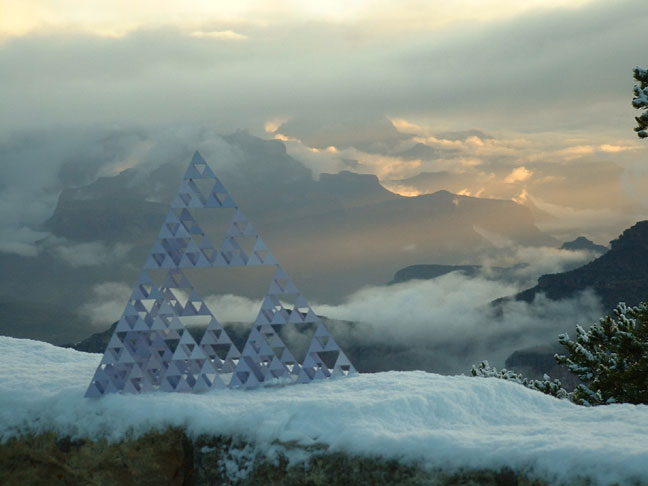
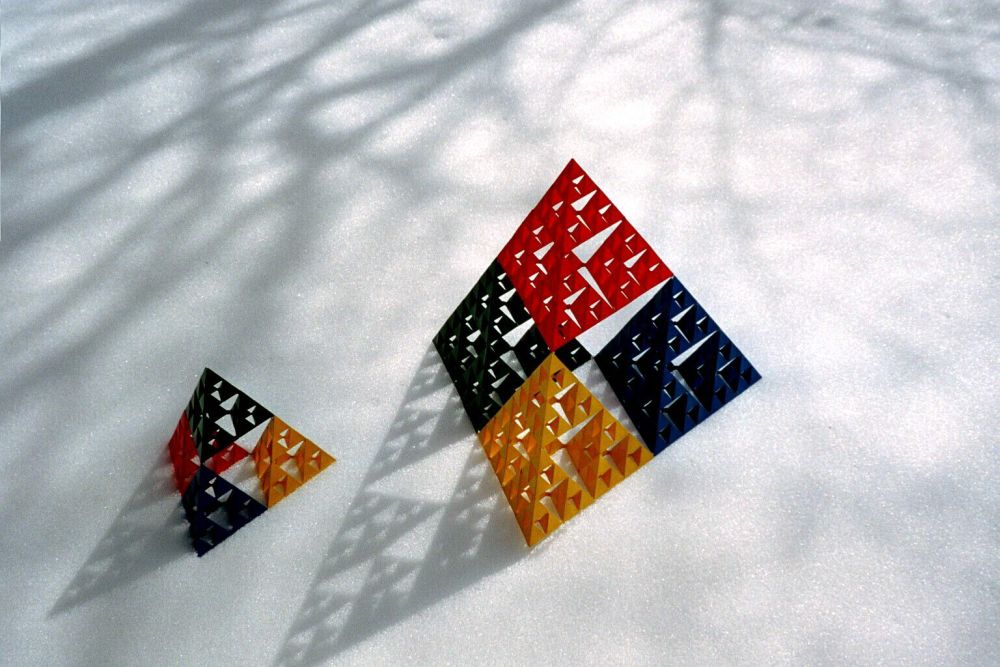

Reprinted from Models of brain function Ed. Rodney M. J. Cotterill
© Cambridge University Press, 1989 Printed in Great Britain
Neural Geometry: Towards a Fractal Model of Neurons
A.J. PELLIONISZ
New York University Medical Center
1. GEOMETRIZATION OF BRAIN THEORY
The purposefully "controversial" and therefore long overdue geometrization of brain theory (cf. Pellionisz 1987a,b, 1988a,b, 1989a,b,c) receives major impetus once one can break away from what we were indoctrinated to hold as "Geometry"-that of the uncontroversial Euclidean space. The utterly simple structure of E.g. a physical "space" spun by an x,y,z orthogonal Cartesian reference frame would certainly do for such mundane tasks as parceling one's backyard. One does not have to be a "neurophilosopher" (c.f. Churchland, 1986) to admit, however, that the orthodox Euclidean geometry is not necessarily adequate for a modern geometrical interpretation of structurofunctional properties of some more sophisticated mammalian brains.
1.1. Metric Tensors Say it All ?
An axiomatic shift from extrinsic orthogonal Cartesian frames to intrinsic generalized (nonorthogonal, overcomplete) coordinate systems is well documented in the field'of gaze transformations by neural networks (E.g. from covariant vestibular sensory coordinates to contravariant neck-motor coordinates, via the cerebellar metric tensor; cf. Pellionisz and Peterson 1988, Peterson et al. 1989). Such metrics express an obviously non-Euclidean geometry (see non-zero off-diagonals in the 30-dimensional metric tensor of neck-motor space; ibid). Moreover, since such metric tensors are position-dependent, even rudimentary sensorimotor functional manifolds are shown to represent curved multidimensional hyperspaces. But these are at least still metrical spaces. Are non-metrical neural geometries totally excluded?
Not at all. As it often happens in the history of science, an initial seemingly subtle switch in the basic axioms can leadresearch further and further away from the orthodox direction along which a "taken for granted" rail of thought would blindly take us. The purpose of this paper is to show that single neurons, closely viewed, reveal a dendritic arbor reflecting a grossly non-metrical fractal neural geometry.
1.2. Geometrization of Single Cell Models: Reduction or Conservation of Complexity ?
A close look at single nerve cells is warranted not merely by the anatomical beauty of dendritic arbors which keeps mesmerizing generations of morphologists since Cajal (1911). Indeed, no scientist with true respect of anatomical wonders of nature would dare to consider all nerve cells the same! A fresh look at individual neurons is also long overdue because it is becoming
painfully evident that there is a lack of a single unit model that would both encompass complex physiological (membrane), anatomical (dendritic) properties as well as identify a well-defined computational function, and at the same time could be used as units in neuronal network models. Yet a realistic single cell model, that could also be integrated into neural nets, is vital for the rapidly emerging field of neurocomputing!
1.3. Reduction to Algebra
The venerable McCulloch-Pitts neuron model (1943), while still in use for the meager choice of alternatives, falls short of the above goals from three serious points of view. One is an almost complete disregard of single cell morphology. Neural shape and form is considered irrelevant. All neurons (with a variable n input lines) are essentially equivalent. Electrical phenomena on dendritic trees are left untreated. A second set of problems (in part since this pioneering model was contrived before the dominance of electrophysiology) is the complete ignorance of membrane phenomenology. The "all or none" square pulse of a "flip-flop" disregards those complex ionic mechanisms (approximated by the classical Hodgkin-Huxley equations as early as in 1952) that produce intricate depolarization-curves, giving rise to spikes with various shapes and forxns. Third, the McCulloch-Pitts neuron identified the intrinsic mathematics of neural nets as algebra (as opposed to geometry). Specifically, the computational understructure of the function of neural nets was squarely equated with Boolean algebra (Turing 1948); the mathematical language of serial (von-Neumann) computers. Thus, McCulloch-Pitts neurons (1943), together with the "Hebb-rule" (1949) of the modification of their synaptic efficacies, are still the "nuts and bolts" of building brain-like machines. No wonder that they often turn out as mere variations, multiplexed versions of von-Neumann computers! This is in spite of the fact that the diametrically opposite conceptual foundations of algebraic serial computers and geometrical massively parallel brains were clearly discerned a generation ago (von Neumann, 1958).
It is not that there were no heroic contributions to the geometrization of single neuron models. There were at least two most outstanding endeavors that incorporated the phenomenology of both of the geometrical properties of dendritic trees and electrophysiological properties of neurons (that are in part determined by dendritic geometry). Nonetheless, both seminal contributions left room for further improvement in two aspects; towards extracting abstract computational properties of neurons, and providing a single neuron model that could be practically used in "neural net',' applications.
1.4. Reduction to Closed Analytical Formula, Applied to an Euclidean Shape (Cylinder)
The first memorable attempt was that of Rall (1964). He introduced the brilliant "equivalent cylinder model", an epitome of the Galilean definition of the success in modeling; "unification, simplification, mathematization" (Churchland, 1985). As far as the passive spread of depolarization was concerned, the complex arbor of a dendritic tree could be mathematically equated with simple Euclidean geometrical primitives (cylinders) provided that the bifurcation of the branches followed Rall's "three halves rule"; i.e. that the diameter of the "mother branch" R and those of the "daughter branches" r obeyed the branching power of n=3/2:

Rall's pioneering model ushered in the new era in which dendritic trees were functionally rediscovered. This seminal contribution generated a multitude of quantitative studies concerning electrical phenomena over nerve cell dendritic arborizations (for reviews see Adelman 1971, Cole 1972, Jack at al. 1974, McGregor 1988, Koch and Segev 1988). For at least a decade, the mathematical elegance of a closed analytical formula captivated workers although it was never claimed that the model identified the computational function that single neurons perform in a large neural network. More ominously, evidence started to gather questioning the validity of the very assumptions that were the basis of the mathematical equivalence. First, serious doubts arose if dendritic trees were truly passive, in view of reports claiming that at least on some neurons electroresponsive activity in dendrites can be observed (cf. Koch 1984, Sheperd et al. 1985). Second, "harder" anatomical evidence convincingly documented that the "three halves rule"does not in fact hold for existing neurons. Quantitativecomputerized histology established that the branching power in various neurons of several species (e.g. rats and cats), instead of obeying the theoretical 1.5, ranged up to 2.58 (for cerebellar granule cells), with the lowest branching power being 1.69 (for motoneurons). Specifically, for cerebellar Purkinje cells a branching power of 2.36 was measured (all these data are from Hillman 1979). While an integer branching power of 2 could be justified by the argument of "conservation of dendritic cross section area" that might serve some useful purpose (Hillman 1979), the more typical real values, grossly deviating from 1.5 put severe constraints on the utility of Rall's brilliant equivalent cylinder model.

Fig.1 . Levels of Analysis Necessitating Reduction of Complexity (from Pellionisz 1979). A: Hodgkin-Huxley-type membrane equations (1952) that govern electrogenesis in a cylindrical segment. B: Compartmentalization of an ad-hoc Purkinje cell dendritictree. C: Superimposed intracellular recordings of climbing fiber response (CFR) in a cat Purkinje cell, and in the frog (D). E: Computer model (from A-B) explaining the phenomenology of intracellular electrophysiology of CFR. F: Representative neurons from a model of 1.68 million neurons, approximating the neuronal network of the frog cerebellum. Levels of neural complexity are grossly incongruous, unwieldy, and phenomenological.
1.5. Numerical Integration of Nonlinear Differential Equations, Applied to a Compartmentalized Set of Arbitrary Euclidean Shapes
Compartmental models, pioneered by Cooley and Dodge ( 1966) with a wide followership (Jack et al. 1971, Rinzel 1978, Pellionisz 1979, Traub and Llinas 1979, Traub 1982, Koch et al. 1982, Crill and Schwindt 1983, Pongracz 1985, Shelton 1985, Sheperd et al. 1985, Rall and Segev
1988, Koch, Segev 1988 Borg-Graham 1988) directly addressed both problems, plus corroborated membrane equations with single cell morphological and electrophysiological data. The compartmentalization-approach was motivated by electrophysiology of single cells - a majordrive behind neuronal modeling in the sixties and seventies. Those who modelled neurons for a mathematical understanding, leading us to brain-like "neurocomputers", could not even hope for independent support of such useless passion at that time! Quite simply, the enormous data-turnout of that field of research, that has been massively supported for decades, was badly in need of some quantitative synthesis. However, the prevailing trend was to aim towards increasingly finer focus and more and more detailed phenomenological models, leading to an ever-increasing number of free parameters of integrative models. Thus, the state of art in single cell modeling entails literarily thousands of compartments (Shelton 1985), and getting down not only to the level of dendrites (Sheperd at al. 1985), but of dendritic spines (Koch and Poggio, 1983) and individual channels (Crill and Schwindt 1983, cf. Borg-Graham 1988). Modelists, with an eye on synthesis, heroically attempt to close the gap (Rall and Segev 1988).
The compartmental method is based on numerical integration of the updated Hodgkin-Huxley type membrane equations. Therefore, as seen in Fig. 1, spatial compartments of an arbitrarily complex dendritic arbor can bespecified ither as totally passive, or partially or fully active electroresponsive units, and spatial parameters (lengths and branch-diameters) could be freely specified to conform E.g. with any desired "branching power". An obvious advantage of such compartmental single unit modeling is that the phenomenology of complex structuro-functional properties could be approximated to any desired degree of precision. Taking an example from earlier studies of this author; the so-called complex spike response of the Purkinje neuron could be accounted for (compare Fig. 1 CD versus E). The complexity conserved by such models is limited only by the expenditure on computation. Deploying supercomputers, no limit in complexity would be in sight. Nonetheless, such naked "brute force" phenomenology remains both "not complex enough" ; as any compartmental model remains an asymptotic approximation of real dendritic trees, and at the same time "much too complex" since such models based on numerical integration are already grossly inadequate to be synthesized into neuronal networks containing hundreds of thousands of such units (Fig.lF).
There remains therefore a paradoxical need both to reduce the staggering complexity of dendritic trees and to do it in a manner that reduction does not exclude, but in fact would accomplish, a conservation of complexity. Such an approach should retain a flexibility for interpreting a range of real-valued branching powers as well as permit a "mosaic" of various electroresponsive regions over a dendritic tree. This paper argues that the approach of fractal nerve cell modeling initiated here will bring us closer to these hitherto elusive goals.
2. THE FRACTAL MODEL OF NEURAL ARBORIZATION
The plausibility that neuronal arborizations may reflect fractal geometries is substantiated by the fact that arbors of various plants and bushes could already be approximated by fractals. Fractal geometry, although not much older than a decade (the term "fractal" was coined by the "grandfather" of the field, Mandelbrot in 1975), already provided with an array of examples that closed-form codes lead to natural realism in generating geometries (Kawaguchi 1982, Aono and Kunii 1984, Smith 1984 Sullivan 1985, Stanley and Ostrowsky 1986, Barnsley et al. 1988).
Indeed, in his epoch-making book on nature's geometries, Mandelbrot ( 1977) surmised that "it would be nice" if neurons, specifically Purkinje cells of the cerebellum, turned out to be fractals. Nonetheless, this notion was left conjectural - a beautiful challenge to neuroscience.
Beyond physical appearance and a deeply felt "philosophy" that neurons are not Euclidean primitives; spheres and wires, there are three further reasons that compel one to initiate a devoted study of this left-open possibility. Three major principles of the procedure are evidently common in generating neural dendritic trees and fractal arbors. One is the principle of "self-similarity", and the other is the use of recursive algorithms; "code-repetition". Third is the previously mentioned rule of showing a branching power, which appears to reflect a "fractal dimension" of successively reducing, by a real-valued ratio, spatial parameters of increasingly higher-order branches of the dendritic tree.

Fig. 2. Self-Similarity. A main principle of fractals, that the whole is similar to its parts, is qualitatively demonstrated for classical Golgi-stained Purkinje cells (from Cajal 1911, Fig.52). Similarity of the arborization of individual cells is shown in A (compare the patterns of two Purkinje cells). A separated Purkinje cell is shown in B, where branchlet of the top right corner is framed. This part magnified (C) displays a qualitative similarity of arborization of the entire neuron (B). Note the limitations and imperfections inherent in using drawings of classic Golgi-stained material.
2.1. Self-Similarity, Code-Repetition and Fractal Dimension
The "self similarity principle" is expounded based on the hypothesis that biological growth follows the mathematical principles of creating a fractal geometry. Growth is based on a repeated access to the genetic code. Thus, for instance, growing two main branches from a trunk of the dendritic tree, and later when in the growing process a tiny twig bifurcates into twiglets, the mother- and daughter branches are characteristically self-similar. This fact may well be based on growth-stages being governed by a recursive process determined by a repeated access to the same "code".
Although quite new, the general methods of fractals and mathematical methods of generating fractal arbors are amply presented in detail in literature (Blanchard 1984, Falconer 1985, Mandelbrot et al. 1985, Amburn et al. 1986). In modeling single neurons, their structural geometry has traditionally been represented by Euclidean shapes (spheres and cylindrical
segments) -just as it is customary to geometrically characterize all man-made objects by such primitives. In contrast, methods of fractal geometry are based on the general principle that if an object is distributed into N parts, each scaled down by a ratio r from the whole, then the dimensionality D can be a real, not just an integer number:
D=logN/log(1/r)
Such a recursive code, generating a hierarchy of elements, each "scaled-down" from the previous by a fractal dimension D, leads precisely to a geometry where the part is very much like to whole. This so-called "self similarity principle" is a strikingly demonstrable feature of dendritic geometry (see Figs. 2 and 4). As shown in Fig.3A by the classic diagram of embryonic Purkinje cells by Cajal (1911), this phenomenon may well be based on growth-stages being governed by a recursive process determined by a repeated access to the same "code".
Fig.3. Fractal Growth Model of Dendritic Arbor by Code Repetition. Top inset A (from Caja11911 , Fig.69) documents that Purkinje cells in embryonic stage ofdevelopment consist of a basic "spatial code". A similar"spatial code" (C) arising from a trunk (B) grows in this fractal model into a realistic dendritic arbor in two further generations (D and E). The fractal arbor is generated in this paper by the so-called "String Re-Writing L-system" originally developed by Lindenmayer, Smith, Prusinkiewicz and Saupe, c.f. Barnsley et al. 1988. This method replaces line segments, in subsequent stages of growth, by the whole "spatial code". The code is shown here in C, to be compared with the "budding" neuron in A above C.
As mentioned, data available in literature (Hillman 1979, before fractals emerged) lend themselves to the interpretation here that Purkinje cell arbors, rather than following Rall's 3/2 rule, conform with a fractal dimension corresponding to the branching power of 2.36. As for the angular pattern of the arborization, the method of iterated function system (referred to as IFS-code) is used (Barnsley et al. 1985, 1988).
Fig. 3. illustrates the use of these procedures on a contemporary graphical workstation for generating a fractal model of a Purkinje cell (cf. Pellionisz 1989a,b). Graphical modeling techniques and methods are in use to investigate and replicate various specific dendritic arbors, most particularly the cerebellar Purkinje cell.
The initial plausibility study (shown in Fig.3, corroborating early stages of fractal growth with
embryonic development of Purkinje cells) encouraged a more detailed analysis of a contemporary graphical renderings of a Purkinje neuron. One of the most recent and best Purkinje cell renderings is found in Tank et al. 1988; displaying a fluorescent calcium-image From guinea pig slice preparation. This neuronal arborization is reproduced from the literature(Figs.4B and 5F).

Fig.4. Self-Similarity Demonstrated by a Contemporary Purkinje Cell Rendering: Central inset B displays a guinea pig Purkinje cell (from Tank et al., 1988; fluorescent Ca-recording in a cerebellar slice-preparation). Top left corner of this dendritic arbor is shown (magnified) at left (A), and top right branchlet is displayed in C. Note the qualitative similarity between the whole neuron and its parts.
Self-similarity of (top left and top right) branches of the dendritic tree is qualitatively apparent in Fig.4 (compare B with either A or C). Both the whole dendritic tree and its parts are essentially composed of a main trunk, bifurcating in a Y-shape manner, with subsequent bifurcations mimicking this basic "spatial code". It could be noted that this contemporary high-resolution mapping of a Purkinje cell is much more suitable for anatomical reconstruction than ancient drawings from Golgi-stained material. Accordingly, as illustrated in Fig.S., a surprisingly simple "code" (see inset B in Fig.S) is suitable for producing, in three successive generations, a fractal model of the dendritic tree. The fmal result is shown in Fig.SE, which is qualitatively directly comparable to the real Purkinje cell of the guinea pig (Fig.SF). Beyond the general pattern of arborizations, note the Y-shaped endings of the fractal tree, mimicking similar branchlets of the real Purkinje cell.
A computerized video-display (shown in Pellionisz 1989b) has also been constructed, demonstrating the growth-process of fractal neurons of Figs. 5. and 3.
3. IMPLICATIONS OF FRACTAL NEURAL GEOMETRY
This paper serves the basic purpose of substantiating the "conjecture" of fractal growth of dendritic trees of nerve cells. Fractal models display self-similarity of micro- and macrofeatures of the arbor. It is argued that the bifurcation-rule of branching expresses a fractal dimension, and the model reveals some simple codes responsible for generating dendritic arbors. The road towards developing a full structuro-functional fractal model of neurons is certainly long and-as most geometrizations in natural sciences-probably uphill. Nevertheless, it opens up several possibilities and thus appears well worth pursuing.
The simplest aspect of further progress is that nerve cells other than Purkinje neurons could also be investigated. Indeed, while Purkinje cells display among the most dramatic-looking dendritic
arbor, it is an exceptional simplicity that they are practically flat and thus lend themselves to direct two-dimensional analysis. Although full three-dimensional fractal reconstruction necessitates a generalization of the "String Re-Writing L-Systems" used in this paper, that particular difficulty is only technical and can be overcome with relatively modest effort.
The preliminary fractal reconstruction in Fig.S, however, also flashes out an agenda ranging from immediately possible tasks to more remote but potentially very important endeavors. 3.1. Accelerating Agenda of Geometrization
3:1.1. Quantitative Computerized Histology: Aiming at Fractal Parameters
One of the most direct and eminently feasible implications of the above study is that it provides with a new guidance for existing efforts in quantitative computerized histology (cf. Hillman 1979). One immediate possibility in computerized quantitative histology is the shift from measuring branching powers of dendritic bifurcations towards establishing the fractal dimension in a large enough anatomical sample of various neurons. In a more global sense, facing any geometry (including that of neurons) one of the most important search is directed towards disceming its invariants. Remember the notion by one of the most significant geometer of all times, Felix Klein (1939): that "geometry is the theory of invariants"! By comparing Fig. 5B and E it is clear that the "spatial invariants" of the tree are encapsulated in the simple "code" in Fig.5B. Actual measurements of the very few quantitative parameters on a sufficiently large sample of Purkinje neurons could conclude in such a "seed" of the "Platonic Purkinje cell", and similarly in "seeds" of other types of neurons. In addition to the volume of such research projects requiring computerized quantitative anatomy, a sizable effort is necessary to elaborate the present preliminary fractal model (which is hitherto totally deterministic) towards a biologically more realistic stochastic theory of "random" fractals (Mandelbrot 1977).
3.1.2. Neural Modeling: Reduction and Conservation of Complexity by Fractals
As outlined in the introduction of this paper, an important motive behind fractal neural models is their capacity to both reduce complexity and at the same time conserve the full richness of the structure of the arbor. It is noteworthy that a similar reduction and conservation is attained by the genome; this is why the "code" (cf. Fig.SB) is also called"seed" in this paper. It is evident, that at this preliminary stage of fractal modeling, the encapsulation of neural complexity has been demonstrated in this paper only in a structural sense. But various types of neurons are built differently not for reasons of anatomy but their function. Thus, the hypothesis here is that a "shape-code" of a specific class of neurons is probably highly influential on the electrophysiological properties of that type of neuron. Also, since nature evidently developed a morphological "self similarity" of micro- and macro domains, there is a reasonable likelihood that a "self similarity" may show up in electrophysiological properties of micro- and macro domains of neurons. One is prepared to follow up these functional implications by applying a systematic analysis (with the use of the proven compartmental modeling technique) to fractal "seeds" versus various 1-5 generation arbors. While it is difficult to exactly foresee all implications of such enormous reduction/conservation at this outset, it is a distinct possibility that a hypothetical "spatial code" of the distribution of electroresponsive areas over a dendritic tree, if confumed, could lead to a structuro-functional single unif model that encapsulates essential
functional geometrical properties of the particular neuron-type. Another likely implication is :hat the classical Hebb-rule (that hypothesized synaptic efficacy-changes over the whole iendritic tree as a function of the single scalar of output firing of neuron) could be "dimension~lly upgraded" by the use of the fractal model such that the scalar becomes a neuron-specific-activity-matrix, over the whole tree. Such a matrix, in fact the functional expression of dendritic geometry, would determine the built-in learning propensities of the specific neuron.

Fig.5. Demonstration of the Feasibility of Fractal Models to Reduce and at the Same Time to Conserve Complex Arborizations. A-D show an initial trunk and three subsequent stages of fractal growth of an arbor, using the "spatial code" displayed in B. Comparison of B and C well illustrates the "string re-writing L-system technique"; dendritic branches replaced by a fractally proportioned whole "code". The fourth-generation fractal tree is shown in E, which is to be compared with the real guinea-pig Purkinje cell dendritic arborization shown in F (same cell as in Fig.4).
3.1.3. Neural Growth: Structural Manifestation of Repeated Access to Genetic Code
One of the most basic, but in all likelihood rather remote, implication of the emerging fractal neural modeling is that it corroborates a spatial "code-repetition" of the growth process with the repetitive access to genetic code. This conceptual link between the two meta-geometries of double helix and "fractal seed" may ultimately lead to precisely pinpointing those exact differences in the "genetic" code that lead to a differentiation to Purkinje-, pyramidal cell, Golgi-cell or other type of specific neurons. It must be emphasized, however, that establishing a rigorous
relation of these "code sequences" to the genetic code that underlies the morphogenesis of differentiated neurons may be far in the future. So is the use of any eventually established "recursive code" to generate semiconductor-based electronic neuromimes, E.g. by manipulating diffusion-properties according to such codes. These ultimate problems of fractal growth are enormously complicated by such facts that E.g. the emerging structural elements (either in biological or non-living medium) are not independent of one another the growth of neighboring dendritic branches may seriously affect one another through the extracellular milieu.
3.2. A Broadening Perspective of Neural Geometry
Raising sights above Euclidean spaces it is apparent that metrical properties of (quasi)linear, derivable multidimensional manifolds (e.g. those governing gaze; Pellionisz 1988a ) are but the simplest features of neural geometry. Upon very close examination a fractal understructre emerges. At the other end of the spectrum it is also known that if large neural networks revert to a nonlinear and non-metrical domain then strange attractors may emerge, revealing (for instance, in EEG) a chaotic geometry (Guevara et al. 1983, Chay 1984, Skarda and Freeman 1987). Regrettably, the relation of fractal, metrical and chaotic neural geometries is quite obscure at the moment. Fractal growth can be related to (quasi)linear metrical network transformations and chaotic nonlinear dynamics mostly in terms of mathematics or (worse) of philosophy as yet. Mathematically, transient emergence of non-linear dynamics from a linear domain is well documented, and can be easily demonstrated in physical examples (see transition of laminar flow to turbulence or the transition of a regularly "dripping faucet" into the domain of irregularity; developing a chaotic attractor). Likewise, connection of fractal geometries with chaos is vigorously researched, revealing for instance fractal-like "self-similarity" of the whole chaotic attractor with its parts (c.f. Henon 1976 or Barnsley et al. 1988).
Finally, in terms of philosophy, one may find it remarkable that chaotic, metrical and fractal neural geometries of the macro-, medium- and micro-domains of the CNS appear to be in a difficult relationship. After all, the external world that the brain reflects is laden with a similar problem. Newtonian mechanics, that applies to the medium-domain, is "hopelessly" complicated by "controversial" relativistic- and quantum-mechanics. They are is still a must if one strives to, be a creative scientist; e.g. cosmologist of the macro-world, or particle physicist of the microcosmos - or just wants to avoid being stuck at the mediocre level of an uncontroversial car mechanic.
Acknowledgement: This preliminary study has been conducted in the framework of grant application "Neural Geometry" to NIMH Program "Mathematical/Computational/Theoretical Neuroscience".
References
Adelman WJ (1971) Biophysics and physiology of excitable membranes. Van Nostrand Reinhold, NY
Ambum P, Grant E, Whitted T (1986) Managing geometric complexity with enhanced procedural methods. Comp. Graphics
Aono M, Kunii TL (1984) Botanical tree image generation. IEEE Comp. Graphics & Appl. 10-33
Barnsley MF, Demko S (1985) Iterated function systems & the global construction of fractals. Proc. Royal Soc. I,ond. A399, 243-275
Barnsley MF, Devaney RL, Mandelbrot BB, Peitgen HO, Saupe D, Voss RF (1988) The science of fractal images. Springer, Berlin
Blanchard P (1984) Complex analytic dynamics on the Riemann sphere. Bull. Amer. Math. Soc. 11: 85-141
Borg-Graham LJ (1988) Modeling the electrical behavior of cortical neurons - simulation of hippocampal pyramidal cells. In: Comp. sim. in brain science (Ed. RMJ Cotterill), Cambridge U.Press, pp. 384-404
Cajal R (1911) Histologie du systéme nerveux de 1'homme et des vertébrés. 2 Volumes, Paris, Maloine
Chay TR (1984) Abnormal discharges & chaos in a neural model system. Biol. Cybem. 50, 301-311
Churchand, PS. (1985) Neurophilosophy: Towards a UnifiedUnderstanding of theMind-Brain. MIT'Press, Boston MA
Cole KS (1972) Membranes, ions and impulses. Univ. Calif. Press
Cooley J, Dodge FA (1966) Digital computer solutions for excitation and propagation of the nerve impulse. Biophys. J. 6: 583-599
Crill WE, Schwindt PC (1983) Active currents in mammalian central neurons. Trends Neurosci. 6: 236-240. Falconer KJ (1985) The geometry of fractal sets. Cambridge Univ. Press.
Guevara MR, Glass L, Mackey MC, Shrier A (1983) Chaos in neurobiology. IEEE Trans. Systm.Man.Cybernet. 13:790-798.
Hebb DO (1949) The organization of behaviour. John Wiley, NY
Hénon M (1976) A two-dimensional mapping with a strange attractor. Commun. Math. Phys. 50:69-77
Hillman D (1979) Neuronal shape perameters and substructures as a basis of neuronal form. In: The neurosciences. IVth study program. FO Schmitt and FG Worden (eds) MTT Pess, Boston pp. 477-498
Hodgkin AL, Huxley AF (1952) A quantitative description of membrane current & its application to conduction & excitation in nerve. J. Physiol. 117:500-S44.
Jack JJB Redman SJ (1971) An electrical description of the motoneurone & its application to the analysis of synaptic potential. J. Physiol. (L.ondon), 215:321-352.
Jack JJB, Noble D, Tsien RW (1975) Electric current flow in excitable cells. Clarendon Press, Oxford Kawaguchi Y (1982) A morphological study of the form of nature. Comp. Graphics.
Klein F (1939) Elementary Mathematics form an Advanced Viewpoint, Dover, NY.
Koch C (1984) Cable theory in neurons, with active, linearized membranes. Biol. Cyb. 50, 15-33
Koch C, Poggio T, Torre V (1982) Retinal ganglion cells: a functional interpretation of dendr. morphology. Phil. Trans. R. Soc. Concl. B. 298: 227-264
Koch C, Poggio TA (1983) Electrical properties of dendritic spines. Trends Neurosci. 6: 80-83 Koch C, Segev I (1988) Methods in neural modeling. MIT Press
Mandelbrot BB, Gefen Y, Aharony A, Peyriere J (1985) Fractals, their transfer matrices and their eigendimensional sequences. J. Phys. A. 18:335-354
Mandelbrot BB (1977) The fractal geometry of nature, W.H. Freeman, New York
McCulloch WS, Pitts W (1943) A logical calculus of the ideas immanent in nervous activity. Bulletin of Math. Biophys, 5, 115-133.
McGregor RJ (1988) Neural & brain modeling. Academic Press
Pellionisz AJ (1979) Modeling of neurons & neural networks. In: The Neurosciences: IV Study Program (eds: Schmitt FO & Worden FGB) MTTG Press, Boston, MA, pp. 525-546
Pellionisz A (1987a) Tensor network theory of the central nervous system. Encyclopedia of Neuroscience , ed. G. Adelman, Boston: Birkhauser
Pellionisz A (1987b) Tensor geometry as the mathematical language of neural networks. Brain theory foundation for neurobotics and neurocomputers. Proc. of IBRO II.World Congress, Neurosci, Suppl. to Vol 22, p. S 101
Pellionisz AJ (1988a) Vistas from tensor network theory: A horizon from reductionalist neurophilosophy to the geometry of multi-unit recordings. In: Computer simuhition in brain science. Cotterill R (eds) Univ. Press, Cambridge pp 44-73
Pellionisz AJ (1988b) Tensor geometry: A language of brains & neurocomputers. Generalized coordinates in Neuroscience & robotics, In: Neural computers (Proc. of the NATO Adv. Res. Workshop) Eckkmiller R & Malsburg Ch(eds) Springer,Berlin381-391
Pellionisz AJ ( 1989a) Neural geometry: Tensor network theory of the CNS. Monograph, Cambridge University Press (in preparation)
Pellionisz AJ (1989b) Neural geometry: The need of researching association of covariant and contravariant coordinates that organizes a cognitive space by relating multisensory-multimotor representation. Proc. of the International Joint Conference on Neural Networks, Washington D.C.
Pellionisz AJ (1989c) Fractal geometry of Purkinje neurons: Relationships among metrical and non-metrical neural geometries. Soc. Neurosci. Abst. (In Press)
Pellionisz AJ, Peterson BW (1988a) A tensorial model of neck motor activation. In: Control of head movement Peterson BW , Richmond F (eds) Oxfotd Univ. Press pp 178-186
Peterson BW, Pellionisz AJ, Baker JF, Keshner E (1989) Functional morphology and neural control of neck muscles in mammals. Amer. Zool. 29:139-149
Poggio T, Torre V, Koch C, (1985) Computational vision & regularization theory, Nature, Vol. 317, No. 6035 Pongracz F (1985) The function of of dendritic spines: A theoretical study. Neurosci. 15: 933-946 Prusinkiewicz, P (1986) Graphical applications of L-systems. Proc. of Graphics. Vision Interface 247-253.
Rall W (1964) Theoretical significance of dendritic trees for neural input-output relations. In: Neural Theory & Modeling, R.F.Reiss, ed. Stanford, CA: Stanford Univ. Press, pp.73-97.
Rall W, Segev I ( 1988) Excitable dendritic spine clusters: nonlinear synaptic processing. In: Computer simulation in brain science. Ed. Cotterill RMJ, Cambridge Univ. Press. pp. 26-43
Rinzel J (1978) Integration & propagation of neuroelectric signals. In: Studies in math. biology. (S.A. Levin, ed), pp. 1-66. Math. Assoc. Am. Washington, DC
Shannon C (1948) A mathematical theory of communication. Bell System Technology J. 27, 3-4.
Shelton DP (1985) Membrane resistivity estimated for the Purkinje neuron by means of a passive Comp. model. Neurosci. 14, 111-131.
Sheperd GM, Brayton RK, Miller JP, Segev I, Rinzel J, Rall W (1985) Signal enhancement in distal cortical dendrites by means of interactions between active dendr. spines. Proc. NaH. Acad. Sci. USA 82;2192-2195
Skarda CA, Freeman WJ (1987) How brains make chaos in order to make sense of the world. Brain Behaviorat Sciences vol. 10. pp. 161-195.
Smith AR (1984) Plants, fractals & formal languages. Comp. Graphics, 1-10
Stanley HE, Ostrowsky, N (eds) (1986) On growth & form: Fractal & non-fractal pattems in physics. (Martinus Nijhoff Publishers, Dordrectht, Netherlands)
Sullivan D (1985) Quasiconformal homeomorphism & dynamics I. Ann. Math. 122:401-418
Tank DW, Sugimori M, Connor JA, Llinás R (1988) Spatially resolved Calcium dynamics of mammalian Purkinje cells in cerebellar slice. Science, 242:633-828
Traub R, Llinás R (1979) Hippocampal pyramidal cells: significance of dendritic ionic conductance for neural function & epileptogenesis. J. Neurophys. 42:476-496
Traub RD (1982) Simulation of intrinsic bursting in CA3 hippocampal neurons. Neurosci., 7, 1233-1242 Turing AM (1948) Intelligent machinery. Rect. Natl. Phys. Lab. Teddington
von Neumann J (1958) The computer & the brain. New Haven: Yale Univ. Press
| |||
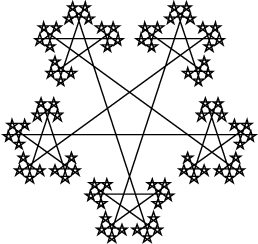 A fractal composed of repeated copies of a pentagram or other polygon. 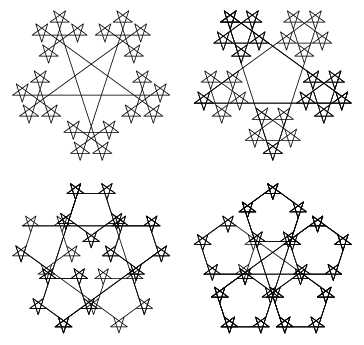 The above figure shows a generalization to different offsets from the center. |


Connecting the Fractal City.
Nikos A. Salingaros
Department of Applied Mathematics,
University of Texas at San Antonio,
San Antonio, Texas 78249, USA
salingar@sphere.math.utsa.eduKeynote speech, 5th Biennial of towns and town planners in Europe (Barcelona, April 2003).
Living cities have intrinsically fractal properties, in common with all living systems. The pressure to accommodate both the automobile and increased population growth led twentieth-century urbanists to impose anti-fractal geometrical typologies. The fractal properties of the traditional city were erased, with disastrous consequences for the urban fabric. To undo this damage, it is necessary to understand several things in some detail: (i) what these fractal properties are; (ii) the intricate connectivity of the living urban fabric; (iii) methods of connecting and repairing urban space; (iv) an effective way to overlay pedestrian, automotive, and public transports; and (v) how to integrate physical connections with electronic connections. First of all, some basic misunderstandings about fractal structure have to be cleared up. I will then underline the nature and importance of hierarchical coherence. We can use the fractal criterion to test the geometry of cities as one condition for their success. Another independent criterion is connectivity, which has to be studied topologically. I will use lessons learned from the evolution of biological systems and the internet to discuss the distribution of sizes, inverse-power scaling laws, and 'small-world' networks. These concepts show us that extreme densities favored in contemporary urbanism -- suburban sprawl on the one hand, and skyscrapers on the other -- are pathological. The challenge for the contemporary city is how to superimpose competing connective networks in an optimal manner.
- Introduction.
- What type of city is fractal?
- Connectivity and the urban web.
- Complementarity and catalysis.
- Hierarchy of connections.
- Capillarity and fractal structure.
- Small-world networks and the World-Wide Web.
- Urban causality.
- Why we eliminated the pedestrian city.
- Green spaces and fractal geometry.
- Interventions to regenerate the urban fabric.
- Conclusion -- the city of the future.
- Appendix I: Fractals and scaling.
- Appendix II: Fractals and the distribution of sizes.
- Appendix III: Redressing network distribution.
1. Introduction.
This essay describes distinct types of cities as characterized by their connective geometry. The different types contain entirely different degrees of urban life. The life of a city is directly dependent upon its matrix of connections and substructure, because the geometry either encourages or discourages people's movements and interactions. Such an understanding is crucial for superimposing the electronic city driven by Information and Communication Technologies. Contrary to what is widely assumed, the electronic city is not an automatic outgrowth of the "high-tech" modernist car city, but in fact connects much better to the more human-scaled 19th century city.
In order to discuss these purely geometric issues, it is necessary to have a clear definition of terms. I spend some time to define "fractal", "scaling", and "connectivity" in the more technical Appendices to this paper. Urbanists might incorrectly assume my title to mean: "Connecting the disconnected city". Yes, contemporary cities are disconnected, but in a separate sense, they are also not fractal. The distribution of the sizes of urban components and connections can define fundamentally different types of city. A picture emerges of a city made of distinct interacting networks, each of them working on several different scales. Though competing, these networks with very different character have to connect with each other, and cooperate in a seamless fashion to define a living city.

Figure 1. Plan of a non-fractal modernist city.
An enormous conceptual gain results from thinking of a city as a multiple fractal structure (Batty & Longley, 1994; Frankhauser, 1994). As urbanists, we free ourselves from the misleading term of a "defining scale", since a fractal exists on all scales. Different urban processes and mechanisms act on different scales. The notion of events happening at all scales and cooperating in some intrinsic manner across scales facilitates an understanding of how a city lives and grows, and makes planning a less haphazard affair. This essay shows why historical cities are fractal, whereas the twentieth-century city is not. The city of the future has to become fractal again. It's going to do this by adapting the relevant geometrical solutions from traditional cities, while incorporating new fractal structure appropriate for new exigencies and new technologies.
I begin this paper by describing what type of city is fractal, and what type is not. The key idea is the existence of linked structure at all scales in a hierarchy, from the very large to the very small. For more technical details, one should read Appendix I. I then outline the connectivity that makes a city alive. Living cities have a vastly larger number of connections between nodes than one expects from the modernist city. For such connections to develop naturally, they require an enormous variety of nodes in close mixing. Monofunctional zoning -- the pivotal notion of CIAM urban planning -- is thereby shown to prevent life in a city.
The rest of the paper discusses the hierarchy of connections necessary to sustain urban life. Competing networks of connections exist on several scales, each scale being necessary for separate functions. Understanding these interconnections is essential if we wish to incorporate the electronic city into the physical city. I criticize the policy of eliminating small-scale connections in favor of large-scale connections -- the city needs both, and in the proper balance. Today's cities have an entirely inadequate interface between the car and pedestrian realms, and I recall proposals by Christopher Alexander that solve this problem. Next, I discuss the efficiency of networks, introducing the idea of 'small-world' networks.
There is a major gap in urban thinking -- the lack of an epistemological framework in which to verify whether urban interventions actually lead to the intended effect, or whether they instead degrade the urban fabric. Determining the causality of urban actions (i.e., what causes what) is essential before we act. I call for a more intelligent, scientific approach to urban intervention. The paper concludes with suggestions on how to regenerate the urban fabric. My proposals include using ideas of Christopher Alexander and Léon Krier to reestablish the pedestrian network, guided by our recent knowledge of the structure of the World-Wide Web.
Three technical Appendices go into more detail in describing the mathematics of urban form. First I discuss fractals and scaling, showing how a fractal is in fact a sophisticated connective structure across scales. Second, I present the distribution of sizes, which tells us how many pieces exist of a certain size when they follow fractal scaling. This result applies to the size of neighborhoods, buildings, urban spaces, green spaces, roads, and paths. Third, I discuss what sort of physical size distribution is compatible with electronic connections. From a mathematical point of view, the electronic city connects best to a traditional city that includes pedestrian connections, and this result is corroborated by evolving patterns of the spatial/electronic interface.
2. What type of city is fractal?
Only older, pre-modernist cities are fractal, because they work on all scales. Mediaeval cities are the most fractal on the smaller scales up to 1 km, whereas 19th century cities work better on larger scales. Urban typologies used throughout history up until the twentieth century lead automatically to a fractal structure (Salingaros, 2001a). Traditional urban form follows the pedestrian transportation web. The predominantly pedestrian city was built over time -- with continuous incremental additions -- on a fractal model, without its builders being aware of it. As I have argued elsewhere, the human mind has a fractal model imprinted in it, so what it intuitively generates will have a fractal structure (Mikiten et. al., 2000).

Figure 2. Plan of unrealistically ordered fractal city.
People actually have to be psychologically conditioned before they can create non-fractal objects. Unfortunately, that is just what our education and media have been doing to us throughout the past several decades. The "image of modernity" is one of sleek, abrupt geometric shapes, and this is perhaps the most powerful force in shaping our cities. Never mind that it has nothing to do with how a living city works and functions -- the simplistic image is what drives us to build. More alarming, it is also what decides which pieces of existing fabric to destroy as being "no longer up-to-date". We have adopted a set of selection criteria that are irrelevant to urban life, and destructive to the urban fabric.
The ideal city of Le Corbusier is a purely large-scale conception, hence non-fractal. Its components are skyscrapers, highways, and vast paved open spaces. Le Corbusier drew skyscrapers sitting in a giant park, everything being defined only on the two or three largest scales. There is little distinct structure seen on the infinite range of scales below the width of skyscrapers, and certainly nothing on the human range of scales 1 cm to 2 m. He missed the necessity of all the smaller scales in a living city. Le Corbusier totally misjudged what his "city of the future" would look like. His skyscrapers did indeed replace the traditional living urban fabric, but they don't sit in giant parks -- urban forces dictate that they instead sit in huge parking lots.
Haussmann's intervention in Paris, on the other hand, can be explained by fractal scaling. When Mediaeval Paris had grown beyond a certain size so that its narrow streets could no longer support traffic, it became necessary to add structures on a new, larger scale. Thus, it became necessary to destroy some urban fabric in order to cut longer/wider streets into the city. Pope Sixtus V did the same to Rome. The same process was behind the introduction of large urban parks -- once the city has extended beyond a certain geographical area, there is a need for a larger green space. Examples of great nineteenth-century parks that replaced urban fabric are to be found in all major cities. In the twentieth century, however, these large-scale urban interventions (roads and parks) were misunderstood, and only their destructive aspect was copied as a model.

Figure 3. Flowing geometry of the city defines urban space.
Urban morphology is a product of the particular transportation system laid down by the government when the city was initially built. Later modifications to the transportation system lead to changes in city structure. Today, governments lay down exclusively car cities (by legislating the road network and infrastructure before anything can be built), or come in and destroy an existing pedestrian city in order to transform it into a car city. In the second instance, pieces of the old pedestrian city might survive to provide at least some remnants of urban life (if the state machine is truly efficient, nothing will be left). For this reason, it is extremely difficult to transform a post-war car city or suburb into a pedestrian city -- one has to rebuild a new pedestrian network into the car city.
Contemporary architecture -- including those styles reacting to minimal modernism -- remains anti-fractal. The reason is that it rejects organized complexity on the human range of scales 1 cm to 2 m. Postmodernist and Deconstructivist buildings, with only a few exceptions, have inherited the ban on pattern, ornament, and decorated materials and surfaces. Their vocabulary consists of high-tech materials and "pure" surfaces, and their structural language is incoherent. As long as a city's structural and connective hierarchy is missing all of its lower scales, the city is not fractal. Despite misleading claims by its proponents, the intentional disorganization characteristic of the deconstructivist architectural style is the opposite of the internal organization of a true fractal.
3. Connectivity and the urban web.
A city's life comes from its connectivity (Dupuy, 1991). All the geometry does is to facilitate the support of a connective web so that human interactions can occur. These are the reason people chose to live in cities in the first place. We need to discuss the connective properties of random graphs to gain some insight into how city life arises (Salingaros, 1998). First consider how connections form. Each connection takes place in order to carry out an information exchange between two nodes (Castells, 1989; Meier, 1962). This information could be encoded in goods. For example, a person needs to go from his house to his office. These two nodes are "house" and "office", and they need to be connected. A physical path structure must facilitate this interaction, otherwise the person cannot function.
Nodes will connect via paths in an entirely abstract manner. Suppose we start with no connections at all, and then randomly connect pairs of nodes, one pair at a time. We don't try to connect all of them deliberately -- each time, a connection is established at random, and may even link two nodes that are already connected. An important mathematical result, due to Erdös and Rényi, states that after a certain number of connective steps, a majority (that is, more than 80%) of the nodes will connect rather suddenly (Barabási, 2002). This is due to the formation of several connected nets of nodes, which grow with successive steps. At the threshold established by Erdös and Rényi, the hitherto separate nets will connect together into one giant net, thus linking most of the nodes together (Salingaros, 1998).

Figure 4. Connecting pairs of nodes at random eventually connects most of them into one network.
The relative number of connections establishes how a living city works (Alexander, 1965). Deliberately connecting N nodes in a minimal way so that two nodes are connected pairwise via one link requires N/2 paths. That is, half the nodes are houses, and the other half are offices, and each house is connected to one office. This is even less connected than a "tree" type of graph (Alexander, 1965). The number of paths necessary to achieve random connectivity equals the far larger number (N/2)lnN . With this number of paths, the majority of nodes are connected through intermediate nodes. Going even further, complete connectivity -- where every node is connected DIRECTLY to every other node without going through any intermediate nodes -- requires N2/2 paths (for large N ).

Figure 5. A pairwise-connected set of nodes does not define a network.
Applying these results to a city provides lower and upper bounds for the required number of paths. Urban life is the interaction made possible when the nodes in a city are connected to each other, either directly or indirectly. We therefore expect that a living city with N nodes have somewhere between (N/2)lnN and N2/2 paths. In order to accommodate all of these connections, the transportation network must be multilayered. In addition, the infrastructure should be sufficiently fine-grained so as to allow many alternatives choices, which generate many alternative paths by permutation. This is the opposite of the postwar consolidation of numerous small urban blocks and streets into a few superblocks and superhighways, a process that severely reduces the number of available paths.

Figure 6. A completely-connected set of nodes.
For a city, N roughly equals the number of people. Setting N = 200,000 gives us the following estimates for the relative number of connective paths. A modernist city of this size has 105 paths, whereas the randomly-connected city has 1.2x10⁶ paths, or 12 TIMES those in the modernist city. Furthermore, a completely-connected city has 2x10¹⁰ paths, or 200,000 TIMES those in the modernist city. The mediaeval city was completely connected via direct pedestrian paths. We built such cities precisely so as to allow direct connections among all nodes, and our collective memory has never forgotten the personal freedom of movement and interaction that this gave us.
Our craving for direct car connections among every urban node makes the car city differ from the modernist city. The 20th century city is a combination of suburban car city and modernist city. In theory, we can connect by car directly to any other point, as long as there is parking, and no other cars want to use the network at the same time. The car increases a person's reach to tens of kilometers. Even more important is the transport and delivery of goods by truck. The price for car accessibility, however, is to sacrifice 50% of a city's surface to roads and parking, and to make our economies hostages to petroleum supplies. Le Corbusier wanted to amalgamate the paths in a modernist city (105 in our example) into one superpath (Salingaros, 1998). His method was to force all residences together into a few giant high-rise buildings, and all offices together into downtown skyscrapers.
4. Complementarity and catalysis.
A fundamental principle is that CONNECTIONS CAN ONLY FORM BETWEEN COMPLEMENTARY NODES. There is absolutely no reason for like nodes -- having similar functional characteristics -- to connect (Salingaros, 1998). Very little information exchange is possible among nodes of the same type. The forces that drive a city to function are generated by diversity and the need for information exchange between different types of nodes. Thus, it makes no connective sense to physically group nodes of the same type into one geographical area. Homogeneous zoning of nodes into monofunctional regions forces non-interacting nodes into geometrical proximity for reasons such as profit for some developer, or the superficial desire for a simplistic visual order. It is antithetical to the basic rules for interactions.
Homogeneous regions that violate the above complementarity rule should not confused with the coherence achieved by an identifiable neighborhood. In a neighborhood, a piece of a city contains sufficient variety and functions to become partially self-sufficient -- at least to the degree that it occupies a specific geographical region. It could possess a particular social or ethnic character. The coherence resulting when every node is connected is a property of the healthy urban fabric, which supports, and is in turn supported by social cohesion. It is the opposite of persons and functions forced into one region either by misguided planning, or by economics, as in a dormitory suburb without commercial nodes, a slum of high-rise apartments without any stores nearby, or an office skyscraper without any residences nearby.
This brings us to catalysis. Many chemical reactions require some form of catalyst, otherwise the reaction rate is too slow to be efficient. Stuart Kauffman (1995) has studied a model in which a set of nodes achieves mutual catalysis to become an autocatalytic set. Each molecule also plays a role as a catalyst for reactions between others. The catalysts are to be found among the molecules that interact -- there is no need to add catalysts if there are enough distinct molecular types. Kauffman finds that there is a minimum variety of different types of molecule that can be put together to define an autocatalytic set (the mathematics is the same as for the Erdös-Rényi theorem). Applied to urbanism, this implies that a city requires an enormous diversity of nodes in close proximity in order to be alive (Salingaros, 2001b). Each piece of the urban fabric catalyzes interactions among the other pieces.

Figure 7. Diverse elements catalyze connections among themselves.
These results establish a picture of a multiply-connected urban fabric that works by autocatalysis. I will briefly sketch out two implications for the urban web. First, every node has to be given several alternative paths for connecting to another node. For example a person should have the options to walk, bicycle, drive a car, take either a public bus or jitney shuttle (private minibus), ride the subway, trolley, or connect electronically to another node. All except the last require physical linear connectivity, and therefore compete for space with each other and with the physical shelter for the nodes themselves. This quality imposes a flowing geometry on the city, which is radically different from the disconnected cubic visual geometry that defines the current architectural and urban paradigm.
Second, we must have sufficient density and variety of nodes so that they catalyze interactions amongst themselves. The vibrant 19th century city mixed buildings containing residential, commercial, light industrial, government, and religious nodes in close proximity to each other (Alexander et. al., 1977; Krier, 1998). The physical structure of the city included the now missing anchors for urban space, such as wide sidewalks, boulevards, and street furniture. A restaurant catalyzes paths among residences, whereas residences in turn catalyze flow in front of the restaurant. All this is destroyed by cutting the connecting paths among diverse nodes (by erecting fences and barriers), and by concentrating similar nodes into homogeneous areas. We now give priority to the parking needs of the car city by building clusters of similar but unconnected nodes.
5. Hierarchy of connections.
The internet offers exciting new possibilities for urbanism (Castells, 1989; Drewe, 1999; 2000; Graham & Marvin, 1996; 2001). It replaces many "dirty" connections that used to require enormous expenditures for fuel and infrastructure. While the dreams of some techno-urbanists of replacing physical transport with electronic telecommuting have not come to pass, the electronic web has indeed begun to merge with the transportation network. Here we face the paradox of the contemporary city -- we do everything we can to connect virtually and by car, but we are disconnected physically on the pedestrian scale (Dupuy, 1991; 1995). Nevertheless, as we replace lengthy car journeys by electronic connections, the more valuable the pedestrian city becomes, though we have lost it in many places around the world.
Many problems of urbanism are ones of scale. A city needs to be connected on all scales. The particular type of connections that function at different scales are very different. Furthermore, since pathwise connectivity is most economical on a plane surface (the ground level), this means that different types of connections are going to compete with each other (Dupuy, 1991; 1995). A city has to balance all these connections. Like in any other problem of competition, the larger/stronger connections have the advantage, and will naturally displace the smaller/weaker connections. There exist fundamental physiological and psychological reasons for why pedestrians require small-scale connections on the ground level. Unless protected, those paths are at risk from other, stronger networks.

Figure 8. Three different competing connective networks shown separated into layers.
We have to be careful that large-scale connections are established strictly according to their place in the hierarchy. Failure to understand this process leads to appeasing transportation forces which push for building more superhighways, while all the lower levels of the transportation hierarchy are erased (Dupuy, 1995). The transportation network -- especially for small trucks -- actually depends on connectivity and not on speed. Much smaller, narrower streets are needed to connect to the urban fabric -- and in many cases, they need to be reintroduced as woonerven (narrow semi-pedestrian roads whose surface limits vehicle speed). The entire pedestrian city can again be built as a protected network interlacing with the sea of automotive traffic (Krier, 1998).
In most contemporary cities, the transportation network erases its lower levels in a misguided effort to become more "efficient". People demand instant access to an expressway, with homes and commercial sites right next to it. They want to skip the hierarchy of connections below the highest scale. Far too many highways are being built today, and far too many low and intermediate-capacity roads are being widened. Of course, the city and the number of cars are both growing, and will soon exceed any temporary new capacity. It makes no sense to be constantly upgrading the entire vehicular transportation network towards the higher scales, because that destroys the smaller scales.
6. Capillarity and fractal structure.
My aim in this paper is to clarify the mechanisms whereby urban society connects on the neighborhood and street levels. I believe the connective structure on those scales to be fundamentally damaged. Only after repairing it can we adapt new patterns in network extension and accessibility. I wish to discuss this in terms of diffusion through capillary channels. Uncoordinated transport occurs via diffusion. Diffusion is not channeled flow -- it is instead the random motion of particles at the smallest level. It turns into flow when all the small-scale movements are directed in the same direction.

Figure 9. Crossover requires capillary structure at the lowest levels.
In order to connect to another network, the elements that use the first network have to transfer through an interface into the second network. Where flow is involved, it has to SLOW DOWN by entering fractal (i.e., progressively narrower) channels leading to the interface. By contrast, a network SPEEDS UP its flow by undoing fractal structure through streamlining. In the first case, geometrical constraints create a lowest level like the capillaries in the human circulation system, where the flow occurs at its slowest and most diffuse, though still fed by the circulation network. Capillarity is the opposite of rapid flow. At the highest level of the network, the strongest channels are wide and smooth to optimize rapid flow. A healthy network requires all levels from the very fast to the very slow.
Misunderstanding the fractal structure of urban networks, cities try to maximize flow everywhere, and in the process eliminate their capillary structure. An obsession with the largest scales in the car network leads to the disconnected urban geometry seen nowadays. The error lies in not recognizing the structure of linked multiple networks, which need to be fractal in order to connect to each other. They also need to be fractal to function properly by themselves, following the structural rules of complex systems (Salingaros, 2001b). Early twentieth-century planners recognized the existence of several competing urban networks, but instead of figuring out how to accommodate all of them, they decided to get rid of those they considered "old-fashioned".
The most glaring omission in contemporary cities is a totally inadequate car/pedestrian interface. Two networks of entirely distinct characteristics have to interface seamlessly without damaging each other. Christopher Alexander (1977; patterns 11, 22, 32, 52, 54, 55, 97, 100, 103, 113) pointed out the fundamental importance of creating and maintaining this fractal interface, and offered practical solutions. Unfortunately, cities instead chose to follow CIAM's opposite suggestions, as they worked very hard to erase their pedestrian network. The first step to destroying a system is to cut its entry points -- i.e., its interface to other systems. The crossover between car and pedestrian realms was eliminated so that the pedestrian city could then be declared "redundant".
The connective interface between people, green spaces, urban spaces, and built surfaces is just as important as the interface between cars and people. We connect most strongly on the most intimate scales (Mikiten et. al., 2000; Salingaros, 1999). That's the reason we love our cars -- we touch their interiors, which in turn surround our body. Urban spaces (with or without green components) were meant to surround us with an inviting, comfortable boundary, but we have recently made them alien and hostile. WITHOUT A SPATIAL INTIMACY CONNECTING US TO THE SMALLEST SCALES, URBAN SPACE IS INEFFECTIVE. Following the dictates of a puritanical architectural modernism, we scorned spatial intimacy in today's cities as something "unmodern", and eliminated it.
Finally, we need to derive "patterns" in the sense of Alexander et. al. (1977) for the emerging interface between the electronic web and the urban web. The advent of the electronic city is just as revolutionary as the growth of the automobile city (Castells, 1989; Drewe, 1999; 2000; Graham & Marvin, 1996; 2001). One consequence of this interaction is the proliferation of the "internet café" around the world. Note that this connection is via a characteristically pedestrian node. Physical intimacy in fact holds true for all entry points into the electronic city -- the portable cellular telephone fits into one's hand, and the computer laptop fits on one's lap. These ergonomic designs integrate with physical connections on the human scale. Unlike the car network (but more like the underground Metro), we don't see the electronic web because it doesn't exist in any competing physical space.
7. Small-world networks and the World-Wide Web.
In talking about connectivity so far, I referred to what is essentially the topology of connections. For much of the discussion, it doesn't matter whether the different paths are long, short, straight, or curved. We know from the distribution of sizes, however, that the paths are going to satisfy some distribution according to their length, width, or capacity (see Appendix II, below). It is now necessary to talk about the length of links so as to establish a hierarchy of connections according to their geometry.
A "small-world" network is one where nodes are connected by both long and short links (Barabási, 2002; Salingaros, 2001b). Starting from a set of nodes with only nearest-neighbor interactions, add a few longer links at random. The result is a drastically improved overall connectivity. This is measured by how many links it takes to get from node A to node B for any two nodes chosen at random. If the nodes are connected only via nearest neighbors, then one is required to go through all the intermediate nodes between A and B. Just a few longer connections provide sufficient shortcuts to improve the connectivity. What has happened is that a system with only nearest-neighbor (shortest) connections has been transformed into one that is closer to having an inverse-power distribution of paths.

Figure 10. A minimally-connected set of nodes with only nearest-neighbor links is made into a 'small-world' network by adding a few longer links.
This is the same result discussed in Appendix II, below. The difference is that now we have started at the smallest scale and have built up to the largest scales. In urban structure, this progression corresponds to the dynamic growth of a village into a town, at which point it loses its initial small-scale connectivity. To regain it, it needs to cut new roads as "shortcuts" that connect spatially-separated regions. As it grows, a city requires larger and larger roads. A NETWORK IS ALWAYS DRIVEN TO ADJUST ITS COMMUNICATION INFRASTRUCTURE TOWARDS AN INVERSE-POWER HIERARCHY. This is the reason why the mediaeval city -- with short-range pedestrian connections -- could not survive unchanged.

Figure 11. Inverse-power distribution of sizes.
For the same reason, however, the modernist city, which is artificially biased towards longer connections, was an unrealistic planning model. The car city that emerged in place of the modernist city requires many short car trips, hence parking lots everywhere. Contrary to what Le Corbusier decreed, people have never used their car to drive solely between their house in a garden suburb and their downtown office. The car is now used for every little chore of everyday life. Not surprisingly, once we have the sedentary connective freedom offered by the car, we demand a direct car connection to every urban node. This powerful force generates commercial suburbia, erasing the compact urban fabric in the process.
The web of public transport that includes subway, trams/streetcars, and light rail was an invention of cities growing rapidly in the nineteenth century. It became necessary to introduce shortcuts between regions of the pedestrian city that were too far apart to connect. The ideal solution was a superimposed transportation network that does not compete with the existing pedestrian and vehicular (early motor and horse-drawn) traffic, hence it was built either underground or raised overhead. The Metro should be interpreted as an extension of the PEDESTRIAN web, since it links regions of the city that are themselves parts of the pedestrian web. Altogether, it's a small-world network that improves its connectivity by introducing a few longer connections.
Failure to understand this causality (i.e., what action drives another action) has led to disappointment when car cities introduce a subway. Just because Paris has a subway, post-war commuter suburbs -- with an existing road grid built for cars -- unrealistically expect that a piece of 19th century European urban fabric will miraculously develop around new subway stops. This has failed to materialize. In a car city, the forces are overwhelmingly focussed on the need for parking around a metro station. Forces that would generate a pedestrian network are simply not present, and the actual needs may prevent any pedestrian web from ever forming there.
The World-Wide Web itself has grown and has self-organized according to a self-similar, small-world structure (Barabási, 2002). That is, it obeys the distribution of sizes that I discuss in Appendices II and III, below, this time for connective links. None of this structure has been imposed -- it has all grown incrementally. Here we have an excellent example of self-organization, the process by which forces manage to act in balance to grow a complex system into a stable working structure. This process is analogous to the miracle of biological growth, as seen in the development of an embryo. A combination of code (in the DNA) and chemical fields leads to the formation of a wondrous complex whole.
When "small-world" networks were first introduced, it was discovered that the nervous systems of invertebrates (which are simple enough to be mapped) indeed obey such a distribution. The need for efficient signal connectivity via a nervous system has evolved exactly this type of network in animals. A city should evolve the same type of network connectivity, but unfortunately it cannot do this automatically. It is necessary to allow both self-generation of urban fabric on the small scale, as well as deliberate intervention on the large scale. This is in fact a central problem of urbanism -- the competition between top-down imposed design, and bottom-up self-generated design. Both processes are misunderstood nowadays.
The bottom-up growth of short-scale connections allows for the free expression of natural urban forces. Left entirely to themselves, however, they will soon develop into random and incoherent structures, as exemplified in the favela or shantytown. The notion (and profession) of "planning" is a reaction to uncontrolled growth. And yet, there is an enormous degree of life that arises in such settings. Under the right conditions, the small-scale connections can be generated more or less spontaneously -- all we need is some encouragement, guidance, and constraints to ensure a partially coherent form. Most top-down interventions today unfortunately destroy living structure. Cities need top-down planning, but it must be based on how the urban fabric grows and maintains itself.
8. Urban causality.
Urban forces due to information exchange generate the urban fabric, just as other urban forces can degrade it or destroy it. A major unanswered question is -- "which forces cause which action, or conversely, what are the consequences of a particular urban action?" We can hardly expect to plan realistically unless we can anticipate the consequences of urban actions and interventions. Nor can we hope to understand how urban form arises if we don't grasp the character, strength, and causality of different urban forces. That topic of inquiry is still waiting serious investigation. Here I can only offer some preliminary thoughts.
Throughout this essay, I have tried to mention cases of urban causality that appear to be fairly clear. Some of these insights are unexpected, however, and run contrary to accepted wisdom. My approach has always been a scientific one -- study urban actions and their consequences. I'm afraid that this is not standard urbanist practice. One could excuse this omission in part by saying that it is extremely difficult to isolate actions and their consequences, because of the complexity of the dynamic urban system. Nevertheless, we finally have sufficient scientific tools that allow a first approach to disentangling the interaction of urban forces, and establishing the mechanisms of urban causality.
I'm particularly worried about the occurrence of urban "viruses" that at first go unrecognized. By this, I mean a trivial or minor tool, idea, or practice that is introduced as harmless into the city, but which eventually destroys it. A historical example is the lead poisoning of Rome after the introduction of lead water pipes, as well as the practice of using lead as a preservative in wine. Perhaps we are facing similar pathologies today of which we are totally unaware. Governments carry out imaginary war scenarios with massive computer simulation (usually in secret symposia), trying to anticipate the worst disasters, and the consequences of even the most minor actions. They are doing the intelligent thing -- planning ahead so that they will not be caught by surprise.
9. Why we eliminated the pedestrian city.
We love a city when we can connect to it intimately. We retain a warm memory of that interaction. This memory consists of visual, olfactory, acoustical, and tactile connections. All of these memories can be formed only on the PEDESTRIAN level, far below in scale than the shortest walkable path. Our largely subconscious memory of a city is formed on a visceral level, on the physical scale of our own bodies. The "soul" of a city exists precisely on its smallest architectural scales. This turns out to include the "detritus" which modernism tried so hard to eliminate -- unaligned and crooked walls, a bit of color, peeling paint, architectural ornaments, a step, a sidewalk tree, a portion of pavement, something to lean against, someplace to sit down outside, etc.
The anti-fractal movement of the twentieth century began with a call to destroy ornament. Architectural ornament is an intrinsic part of the entire city, however, and destroying it destroys one segment of the city's scales. Such an action erases the levels in the urban hierarchy spanning the scales 1 mm to 1 m. Soon afterwards, structures that anchored urban space -- built structures ranging from 1 m to 3 m, such as kiosks, benches, porticoes, gazebos, low walls for sitting, etc. -- were erased. Last came the elimination of sidewalks and the pedestrian connectivity of nearby buildings. What was left was only appropriate to the automobile city, not for pedestrian movement. True enough, it was necessary in the 1920's to accommodate the automobile into the 19th Century city, but not to destroy the pedestrian city in the process.
THERE ARE TWO DISTINCT, CONNECTED NETWORKS -- THE CAR CITY, AND THE PEDESTRIAN CITY. We have allowed the first to erase the second. That action severed human beings from their immediate environment. After living this way for several generations, human beings have accepted a disconnected lifestyle, even as they can never adjust to it physiologically and psychologically. Sadly, it is our own biological make-up that made us accept it. Being fundamentally lazy, we prefer to sit down in a car while connecting directly to nodes up to tens of kilometers away -- there is no need to cross over to different modes of transport. Psychologically, we prefer moving about the city in own own personal (and personalized) spatial cocoon, rather that mixing with strangers in public transportation. We want to connect to a store, office, and our home directly and exclusively by car.
The pedestrian city has something important to offer, which offsets the advantages of the car city, namely -- AN EMOTIONALLY NOURISHING PHYSICAL ENVIRONMENT. There is visual excitement, the joy of physical movement, the thrilling experience of vibrant city life, the sensory stimulation from urban space filled with other people of different types and different ages (experiences that are essentially different from the stresses of city driving). Le Corbusier despised all of this, and he went about eliminating it systematically via the CIAM planning rules. His books on urbanism espouse only the delights of driving around in a sports car. The elimination of urban space, connected green space, and the human scale from the urban fabric removed the unique set of forces that generate and support the pedestrian city.
Urban life requires a connected network of pedestrian urban spaces, whose sizes obey an inverse-power distribution (as outlined in Appendix II, below). A multiplicity of pedestrian paths is harbored and protected by open and semi-enclosed urban spaces. One cannot exist without the other. The network of urban space coincides with and supports the network of pedestrian paths (Krier, 1998; Salingaros, 1999). Architects no longer design urban spaces that people wish to spend time in, however, and any built urban spaces are totally disconnected from the pedestrian network, hence from each other. This major breakdown in the concept of the city is not accidental -- it is a straightforward application of a transportation geometry that is incompatible with urban space, as well as CIAM's prejudice against the concept of urban space itself (Salingaros, 1999; 2001b).

Figure 12. Distribution and connectivity of urban and green spaces.
Modernist prejudices for cars and against pedestrians have supported the unstated dogma that "motor vehicles don't threaten people", a denial of a fundamental psychological perception. So, instead of designing urban space that protects people from cars psychologically as well as physically, we continue to pretend that urban space is not necessary. The same hypocrisy gives priority to cars whenever car and pedestrian meet -- the opposite of what ought to happen. A basic rule of living cities is that pedestrians must always feel safe from moving vehicles.
Human anatomy has scarcely frustrated Le Corbusier's dream of having wealthy people enter their car in the garage of their suburban home, and exiting it in their office's parking garage (on the other hand, the working class was supposed to get along with public transport). His vision of a city without a human scale has very nearly come to pass. Nevertheless, even in today's most disconnected, dysfunctional anti-city, people walk daily to and from their car. It is impossible to eliminate the pedestrian realm altogether. Since these short pedestrian paths are not supposed to exist, they are left geometrically ill-defined. The once glorious pedestrian city has contracted to dreary concrete parking garages and asphalt parking wastelands.
10. Green spaces and fractal geometry.
This paper's ideas apply to the size and distribution of green spaces. A living city requires one very large green space, several ones of intermediate size, and very many of smaller size. In a city, there ought to be a distribution of public green spaces all the way down to tiny neighborhood parks for young children to play in, situated very near their house. This proposal is a theoretical verification of ideas originally proposed by Christopher Alexander et. al. in "A Pattern Language" (1977; patterns 51, 60, 67, 111, and 172). The opposite practice of consolidation, following the myth of the "economy of scale", destroys the natural distribution of green spaces. Suburbs offer what was taken from our cities -- a personal green space for each family (but they have problems with connectivity and low density).
Systemic connectivity occurs (or not) independently of the distribution of sizes. As evidence of our damaged cities, consider the present distribution and connectivity of green areas. It has become fashionable to put isolated pieces of ornamental green (lawn or bushes) in many useless places. While it is in principle good to have these green spaces, no-one can actually walk in them, because they are disconnected from pedestrians and from each other. They serve strictly as visual decoration for the car city, without relating in any way to the pedestrian city (which may in fact be nonexistent). The presence of green spaces of different sizes, even in an inverse-power distribution, does not create a network -- they first have to connect on the human range of scales.
Nineteenth century cities worked very hard to provide a connective interface between the natural world of plants, trees, and rocks, and the built environment. This was achieved by means of geometry. Today, all we see is a geometry of disconnecting edges. A plant is an intrinsically fractal structure, however, and does not fit into the modernist machine geometry. Anti-fractal thinking is glaringly obvious in how the built environment is disconnected from plants. An unnatural geometry has been imposed on the natural world. Modernism prefers perfectly flat lawns and bushes trimmed into perfect cubes. Putting a tree into a square planter is a juxtaposition of two mutually exclusive and irreconcilable geometries.
Coming back to the idea of connectivity, green spaces fail in their urban function unless we can connect to them physically on a pedestrian level. Inaccessible lawn and trees, either because they are in the private domain, or because they are adjacent to a highway, do not form part of the urban fabric. These are not nature preserves, which require a degree of protection from pedestrians. We have become confused by the CIAM thinking embodying disconnectedness and segregation (not only in relation to green spaces, but in almost everything else having to do with the urban fabric).
11. Interventions to regenerate the urban fabric.
The principal obstacle to urban regeneration is our society's philosophy of disconnectedness. Trying to introduce living urban fabric nowadays runs counter to most people's conception of order. We adopted an urban and architectural typology of nonliving forms in the twentieth century, and now this built environment has taught us a nonliving model of the universe. Our basic understanding of how the universe works is prejudiced by the built examples around us, as well as by an accompanying philosophy that falsely opposes modernity to traditional living processes. As a result, people consider surviving urban and architectural forms that embody life to be "impure", "old-fashioned", and even "reactionary". Within this prevalent worldview, it is extremely difficult to RECOGNIZE living structure, which is a prerequisite for any interventions that aim to GENERATE living structure.
I come back to the basic rule that urban morphology is determined by the city's transportation web. Faced with a dysfunctional city, innovative planning will be ineffective unless the transportation network and infrastructure are changed. That's very difficult to do, and, moreover, it's extremely expensive. Cities might not wish to undertake such a drastic reorganization also for philosophical reasons, since it implies changing their codes of growth corresponding to their "genes". Most cities around the world, however, did successfully change their genes to re-grow a car city out of an initially pedestrian city, so it is in principle possible to do the reverse.
Urban regeneration today separates into two distinct problems -- how to bring the car city to life, and how to revitalize dead pedestrian inner cities. In the first case, we have to build a pedestrian network inside the car city, erasing some of it in the process. Surprisingly, this goal can be achieved without seriously restricting the car/truck network. We need not sacrifice connectivity. The second case -- the slum -- is far more difficult to fix, since it is created by social problems driving out the healthy mixture of urban functions that define a living city. The people who live in an inner-city slum are disconnected from the rest of the city because of high crime, narcotics, and a lack of education and job skills. They lack long-scale social connections for information exchange.
I will not attempt to address the social problems that complicate urban regeneration in the inner city. Nevertheless, understanding one aspect of this complex phenomenon is almost trivially simple. People with very little power and influence should not be blamed for the urban problems the slum now poses. The more powerful economic classes just ceased to value the inner city as an urban environment, and absconded to the suburbs. Someone had to fill the vacated region, and, since no-one with any money considered it a desirable living environment, it was left to those with no other choice. In this interpretation, the slum dwellers serve an essential urban function, filling up regions that nobody else wants.
A combination of bottom-up and top-down methods acting together can recreate the pedestrian city protected from the car city, but connecting to it. The top-down method will legislate mixed-use zoning, and discourage concentrations of homogenous functions. Lower and upper density limits will select against tall buildings, as well as against sparse monofunctional dormitory suburbs. Above a certain minimum density (below which they would not be economically feasible), we can require a percentage of retail nodes to be mixed in with residences. Following the lead of the American New Urbanist Andrés Duany, we need to change the codes, and the city will then evolve towards living structure. The new codes will dictate that the majority of buildings are of mixed use. Tall buildings can be allowed in special situations, with the full understanding that the higher concentration is parasitic to its surroundings.
The other potential for life comes from natural urban forces. The bottom-up component of regeneration relaxes present codes so as to allow owner-built expansion. This is a random growth model that produces squatter settlements and third-world peripheral cities. It nevertheless represents a genuine living urban process that cannot be ignored. It should be constrained so it doesn't grow out of control, and channeling it is more intelligent than trying to eliminate it. Planners have learned (but will seldom admit) that this urban force CANNOT be eliminated entirely -- uncontrolled growth will just occur outside the reach of the official agencies. It is far better to guide this creative force so as to build urban fabric that is more usable, hygienic, and permanent.
Regeneration in existing urban areas ought to be encouraged by offering subsidies for small-scale growth. This is the best and most efficient means of regenerating the smallest scales in cities, which are now missing. At present, the government subsidizes principally large-scale projects, following a planning philosophy of large-scale intervention. It is far easier to spend public money in large sums -- a regrettable accounting feature of every government bureaucracy. That practice has to be modified, so that funds are divided according to an inverse-power distribution. This means handing out a large number of subsidies consisting of a small amount of money for small projects -- the smaller, the better (Alexander et. al., 1975; Salingaros & West, 1999). Nowadays, building small things is almost universally discouraged, or even banned by zoning legislation.
12. Conclusion -- the city of the future.
If we can get over the ideological blinders imposed on the world by otherwise well-meaning but false ideas about "modernity", then we can begin to understand how the urban fabric forms itself and changes dynamically. We can then build new cities that incorporate the best characteristics of traditional cities, while utilizing the latest technology to facilitate instead of frustrating human interactions. At the same time, we can regenerate older cities, which already contain physical structures that would today be impossible to duplicate economically. Those buildings and urban spaces are being sacrificed to an intolerant design dogma, to be replaced by faceless and lifeless rectangular slabs, cubes, and parking lots.
Pathological components of the city can be selected against. Either an underconcentration, or overconcentration of nodes strains the infrastructure and resources of the city. Two extremes are suburban sprawl, and skyscrapers. Individuals desire the first, whereas governments and corporations want the second. Neither is acceptable. The first of these urban typologies uses up most of the automobile fuel in the city for the simplest transportation needs. The second typology concentrates non-interacting people into one building, drawing resources from the rest of the city. The urban forces generated by the overconcentration of a skyscraper tend to erase the urban fabric in a significant area around it. Skyscrapers feed off the rest of the city, and require more infrastructure and larger expressways to maintain them.
The electronic city offers help in two distinct ways. Firstly, it replaces many "dirty" connections of the older city, freeing up infrastructure and fuel consumption. It makes pedestrian pockets in the city much more attractive and practicable than ever before. Secondly, its very structure offers us a template to follow in rebuilding the urban fabric. I mentioned that the internet follows the same structural laws as the traditional city. This should be enough reason to finally discard the misguided, simplistic twentieth-century models of urbanism that did so much to damage our cities. IF WE NEED TO CONNECT THE ELECTRONIC CITY TO A PHYSICAL CITY, THEN THE PHYSICAL CITY MUST FOLLOW THE SAME STRUCTURAL LAWS. By selectively applying successful prototypes from the past, together with insights from the science of networks, we can generate an entirely new type of living contemporary city.
TECHNICAL APPENDICES.
Appendix I: Fractals and scaling.
"Fractal" means "broken", yet that's not what the word denotes in mathematics. Very precise properties characterize a fractal, and which are not usually understood by non-mathematicians. The key notion of a fractal is that it possesses structure on a hierarchy of scales. A structure defined at an overall size x implies something similar at a size rx , where r is a scaling factor like 1/3 . For a structure to be fractal, there exist substructure at decreasing sizes r2x , r3x , r4x , etc. A true mathematical fractal has self-similar structures going all the way down to the infinitesimal scales. For a physical fractal, the smallest scales become too small to see, so this implies a range of scales from very large to the very small.
The number r is called the "scaling factor", and can in theory be any fraction. In most common fractals it is usually some fixed number between 1/2 and 1/10. Naturally-occurring fractals (such as cauliflowers, fern leaves, and the human lung) exhibit a nested structure with r not very different from 1/3 (Salingaros, 1995; Salingaros & West, 1999).
There are two ways to construct a fractal as one goes down to the smaller scales. The first is to ADD substructure, while the second is to SUBTRACT substructure. In the first case, adding structure on every scale creates a folded, crinkled, textured object that is nowhere smooth or straight. A fractal "roughness" is generated on each edge. We have created the analogy to a catalytic surface, where chemicals can come together in close proximity to interact, drawn in by an attraction to the crinkled surface. In urbanism, an undulating urban boundary facilitates human interactions, as for example the edge of a piazza lined with shops and coffee tables (Salingaros, 2001a). Urban spaces that are actually used are almost invariably enclosed by a fractal boundary. Removing the fractal structure by making the edge smooth removes the catalytic geometry for pedestrian interaction, and kills the urban space (Salingaros, 1999).
The other method of constructing a fractal is to create gaps at successively decreasing scales, like punching holes out of a material. The size of the holes gets smaller and smaller, forming a sieve or perforated membrane. In biology, membranes play just as important a role as catalytic surfaces do, since membranes provide the semi-permeable interface between distinct biological regions. In the same way, perforated urban interfaces allow pedestrian flow across an urban boundary, while preventing the flow of cars across the same boundary. Examples include colonnades, porticoes, arcades, small shop entrances, bollards along a sidewalk, etc. (Salingaros, 1999; 2001a). The spaces between buildings are a fractal structure on the scale of the city itself. Enlarging the block size and constructing smooth walls without entrances are anti-fractal actions characteristic of post-war planning.
Fractals have another key property -- that of coherence and self-similarity. This means that the different scales are related by some sort of scaling symmetry. In the simplest geometrical cases, a design is repeated at smaller and smaller magnifications, which serves to tie the different scales together into a whole. In a much more sophisticated application, processes and structures on different scales in a living city cooperate in an essential manner. Coherent structures on the large scale are made of components on the small scale. This is what unifies the distinct scales into a interacting, unified whole, both in terms of their geometry, and the dynamic processes occurring on those scales.
Appendix II: Fractals and the distribution of sizes.
How many pieces of a city are there that measure a size x ? These could be copies of the same type of object, or different objects of the same size. Assuming that a living city is fractal, then there is a simple answer -- "there are p units of size x , where p is inversely proportional to x ". That means that the smaller the urban components, the more numerous they have to be. The exact rule is called an "inverse-power distribution", and goes as p = C/xm , with C and m two constants that depend on the specific situation. Usually, m is an index between 1 and 2. (For those who wish to investigate this formula, m is the fractal or Hausdorff dimension). The other constant C is related to the largest size -- in this case, the overall dimension of the city (Salingaros & West, 1999).
While the distribution of sizes is a continuous distribution (i.e., there is no restriction on the possible sizes), in combination with the scaling rule given previously, the distribution becomes discrete. We can label the scales by an integer n , with increasing n for smaller scales, and talk of the n-th scale in the hierarchy. Let's illustrate this for a scaling factor r = 1/3 and fractal dimension m = 1.5 . The distribution then becomes pn = C/(xn)1.5 = 31.5nk , with k a constant. For example, say that a city obeys such a power law. There will be one structure -- the city -- on the largest size. Fix this overall size at 15 km for an illustration, which normalizes the constant k to equal one. Then, there will be 5 well-defined structures in the city of approximately 5 km in size, about 27 structures of size 1.7 km, and about 140 structures of size 556 m. These are the figures corresponding to n = 0, 1, 2, and 3 in the distribution equation.
The consequences of this distribution rule support earlier results by Christopher Alexander et. al. (1977) and Léon Krier (1998). Our hypothetical city has organized into five main regions of about 5 km (the "cities within a city"). These have 27 subregions (boroughs) of about 1.7 km in extent. Finally, the urban fabric is defined by 140 distinct neighborhoods (the "urban quarter", or "community of 7,000") of about 556 m in size. Working out the consequences for the urban fabric leads directly to Alexander's patterns "Mosaic of Subcultures" (Pattern 8), "Subculture Boundary" (Pattern 13), and "Identifiable Neighborhood" (Pattern 14).
Theoretically, there should be very few structures of intermediate size to these. Of course, there exist urban structures of many different sizes, but the distribution implies a gap between the most obvious sizes. This means an improved definition of large-scale structures by means of an identifiable but permeable boundary -- the opposite of today's amorphous suburban sprawl cut up by fences and barriers everywhere. If we don't find the above sizes applicable to the urban structure under discussion, then it is easy to find another distribution with new scaling parameters r and m . The same goes for the actual scales. If for practical reasons one requires structures at, say, 40 m and 1 m, then the hierarchy adopted must include those scales.
Another point is that the hierarchy continues all the way down in scales. For example, there will be about 20 thousand structures (buildings, urban spaces, green spaces) of size 21 m , corresponding to n = 6. Going down even further, the distribution predicts 531 thousand structures (architectural components, bushes, and street furniture) of size 2.3 m, corresponding to n = 8 , and 387 million structures of size 2.8 cm (architectural ornamentation and natural detail), corresponding to n = 12. We could, of course, go down to 1 mm and below.
The importance of this discussion lies not in the specific figures given above for illustration, but in the picture they present. A fractal (i.e., scale-free) city has structural components at all sizes, from the size of the city all the way down to the dimensions of microstructure in the building materials. This conceptual approach unifies city planning, urbanism, urban space design, and architecture as merely different scales of one broad discipline. Perhaps the most revolutionary aspect of this theory is that it reveals the distribution of built structures to be naturally skewed towards the small scale, thus undoing the large-scale bias of twentieth-century planning.
Appendix III: Redressing network distribution.
Telecommunications fits into the hierarchy of different channels of movement and information exchange in a city (Drewe, 1999; 2000). Having an effectively infinite number of electronic paths of zero physical length agrees perfectly with an inverse-power distribution. Recall (from Appendix II, above) the formula for the multiplicity p = C/xm , with m an index between 1 and 2. When the length of the path x becomes zero, then the number p of paths of zero length is infinite.
The introduction of Information and Communication Technologies does not redress the distribution of physical pathlengths, because it is an independent network. In most cities today, there is a large gap where the shortest paths ought to be. This void in the network distribution can only be filled by physical paths that take less than 10 minutes to walk. Paradoxically, a scientific analysis of networks leads us right back to the traditional city (Krier, 1998). There is a very real danger, however, that people will accept the convenient zero-length electronic connections, and will not attempt to reestablish the missing pedestrian connections.
Even so, telecommunications has drastically altered the distribution of pathlengths towards the optimum. To see this, we need to analyze different physical network distributions. A good single figure that shows this difference is the average pathlength. In the first instance, the modernist city allows only a minimal number of longest-length connections, and no others. Its distribution of pathlengths is peaked at some multiple of the city's size x0 , say x0/3. It is heavily biased towards the longest paths, and therefore the addition of telecommunications partially satisfies a fundamental need for physical short-range connections. The distribution, however, remains distorted because of the large gap where the shorter physical paths ought to be.
In the second instance, the Erdös-Rényi model for a randomly-connected city gives a correct lower figure for the optimum path density, but an unrealistic average length. Its length distribution is also peaked at some fraction of the largest size, say x0/3 (Barabási, 2002). Because of the size of the contemporary car city, this distribution represents car connectivity, thus underepresenting all of the pedestrian connections.
The third instance, which is what we want, is a scale-free city that obeys an inverse-power distribution. It has the majority of its connections on the smallest scales, so the shortest paths predominate. Label the shortest physical path -- say, the distance from one connected building to another -- as xmin . Then, this type of city's average physical pathlength is going to be something like 2xmin . This average pathlength is shorter by orders of magnitude compared to the other two models. One could in theory (and in practice) continue to shorter (and more numerous) pathlengths. Only in this scale-free case does telecommunications fit in neatly with the physical distribution of pathlengths.
REFERENCES.
Alexander, C. (1965) "A City is Not a Tree", Architectural Forum 122, No. 1, pages 58-61 and No. 2, pages 58-62. Translated into many languages. Reprinted in: Design After Modernism, Edited by J. Thackara, Thames and Hudson, London (1988) pp. 67-84. Published electronically by RUDI (2001) http://www2.rudi.net/bookshelf/classics/city
Alexander, C., Silverstein, M., Angel, S., Ishikawa, S. & Abrams, D. (1975) The Oregon Experiment, Oxford University Press, New York. French translation: Une Expérience d'Urbanisme Démocratique, Éditions Seuil, Paris, 1976.
Alexander, C., Ishikawa, S., Silverstein, M., Jacobson, M., Fiksdahl-King, I. & Angel, S. (1977) A Pattern Language, Oxford University Press, New York. Spanish translation: Un Lenguaje de Patrones, Editorial Gustavo Gill, Barcelona, 1980.
Barabási, A. L. (2002) Linked: The New Science of Networks, Perseus Publishing, Cambridge, Massachusetts.
Batty, M. & Longley, P. (1994) Fractal Cities, Academic Press, London.
Castells, M. (1989) The Informational City, Blackwell, Oxford.
Drewe, P. (1999) "In Search of New Concepts of Physical and Virtual Space", paper presented at the Conference: Cities in the Global Information Society: an International Perspective (University of Newcastle, Newcastle-upon-Tyne, November 22-24, 1999). Published in: M. Schrenk, Editor, Beitrage zum 5. Symposion "Computergestützte Raumplanung" -- CORP 2000, Volume 1, Vienna University of Technology, pages 37-44.
Drewe, P. (2000) "ICT and Urban Form: Planning and Design Off the Beaten Track", Delft University of Technology, Design Studio 'The Network City', Faculty of Architecture.
Dupuy, G. (1991) L'Urbanisme Des Réseaux, Armand Colin, Paris.
Dupuy, G.(1995) Les Territoires de l'Automobile, Anthropos, Paris.
Frankhauser, P. (1994) La Fractalité des Structures Urbaines, Anthropos, Paris.
Graham, S. & Marvin, S. (1996) Telecommunications and the City, Routledge, London.
Graham, S. & Marvin, S. (2001) Splintering Urbanism, Routledge, London.
Kauffman, S. (1995) At Home in the Universe, Oxford University Press, New York.
Krier, L. (1998) Architecture: Choice or Fate, Andreas Papadakis, Windsor, Berkshire, England. French translation: Architecture: Choix ou Fatalité, Norma, Paris, 1996. Italian translation: Architettura: Scelta o Fatalità, Editori Laterza, Roma-Bari, 1995.
Meier, R. L. (1962) A Communications Theory of Urban Growth, MIT Press, Cambridge, Massachusetts.
Mikiten, T. M., Salingaros, N. A. & Yu, H. S. (2000) "Pavements as Embodiments of Meaning for a Fractal Mind" Nexus Network Journal 2, pages 61-72.
Salingaros, N. A. (1995) "The Laws of Architecture from a Physicist's Perspective", Physics Essays 8, pages 638-643. Traducción en español: "Las Leyes de la Arquitectura desde la Perspectiva de un Físico", El Hombre y la Máquina, No 16 (Abril de 2001) páginas 12-23. Republicado en: La Simetria (Febrero de 2002) approx. 12 páginas.
Salingaros, N. A. (1998) "Theory of the Urban Web", Journal of Urban Design 3, pages 53-71. Finnish translation: "Kaupunki Verkostona", Tampere University of Technology, Institute of Urban Planning, publication No. 33 (2000).
Salingaros, N. A. (1999) "Urban Space and its Information Field", Journal of Urban Design 4, pages 29-49.
Salingaros, N. A. (2001a) "Fractals in the New Architecture", Archimagazine, approximately 6 pages. Traduzione in italiano: "I Frattali Nella Nuova Architettura", Archimagazine (2001), circa 6 pagine.
Salingaros, N. A. (2001b) "Remarks on a City's Composition", RUDI -- Resource for Urban Design Information, approximately 14 pages. Finnish translation of the first half: "Kaupunki ei todellakaan ole puu", Yhteiskuntasuunnittelu -- The Finnish Journal of Urban Studies 39 (2001), pages 68-76.
Salingaros, N. A. & West, B. J. (1999) "A Universal Rule for the Distribution of Sizes", Environment and Planning B 26, pages 909-923.
The floating city of Atlantis is shaped like a snowflake, fractal geometry, 6 sides, Star of David, Flower of Life, Qabbalah, creation. It rose from the sea of creation, grid matrix, collective unconscious, akashic record, blueprint of this program.

Once again we move to bloodlines with Stargate Atlantis. This time we reference the genetics of the ancients, some of who remained on Earth and procreated. Their progeny moved through the millennia until the time was right, the time of activation. This is the time we return home.
Twin Spiraling Ladders of DNA, Movement of Consciousness, Awakening
Fractal Reactor: Re-Creating the Sun
“Subconscious Thoughts on the Fractal Reactor,” 2006, Ink on black photographic paper; sculpture of 300 million degree Kelvin plasmas suspended. 9ft. x 31ft. (Installation view: Ronald Feldman Fine Arts, New York City)
Todd Siler, “Fractal Reactor,” 2000 Mixed media, 8”h x 10”w x 10”d (Model fabricated by Roger Leitner)
Todd Siler, “Supposition and Premise 1 & 2,” 2006. Mixed mediums on natural paper, 44”h x 42”w x 3”d and 48”h x 55”w
Todd Siler, “Designs for the Fractal Reactor’s Magnetic Confinement System,” 2006. Miced media on paper, 32½” x 127”
Related links and info:
Lilly Wei's art review, "Todd Siler at Ronald Feldman," in Art In America (February 2007 Issue, pages 141, 142
A.R.T.Strings
Todd Siler: A.R.T.Strings

Installation view of A.R.T.Strings at Ronald Feldman Fine Arts, NYC, 2004 (detail)
We compress and expand everything, as naturally as gravity distorts time and shapes space. These compressed expansions and expanded compressions affect everything under the sun: from our sense of truth to our experiences of beauty; from blissful joys to beastly horrors.
Today we find ourselves staring at the edges of things, wondering about the subliminal stories our minds create to cope with our eternally turbulent universe, and potentially terrifying future.
Are we, as physicists and string theorists relate, merely anonymous creations of invisible strings of matter too subtle to see? Does each nameless string contain a world of information that will forever elude the touch of human understanding? Does every string embody All Representations of Thought? Do A.R.T. Strings link everything from tranquility to terror?
Perhaps life is only one pattern nature represents in infinite ways with all strings attached.-- Todd Siler
Installation view of A.R.T.Strings at Ronald Feldman Fine Arts (detail)
"A.R.T.Strings expands on my ongoing exploration of nature’s connectivity, which is expressed in all its creations. It advances my adventure in delving into the human mind to discover how we create, learn, discover, and communicate. For me, A.R.T. encompasses All Representations of Thought: from the poetic gestures of dancers to the abstract symbolic models of chemists; from back-of-the-envelop idea doodles to rigorous proofs by pure mathematicians; from the Aha! we spontaneously utter at a moment of breakthrough to the technological marvels we create in collaboratively harnessing our creative genius; from our silent muses on life to our tangible responses to all the things nature shares with us every second of everyday—things that challenge our senses and imagination".
Excerpts from: A.R.T.String: A Guide To The Works of Todd Siler. Boulder, CO: Boulder Museum of Contemporary Art and the Museum of Outdoor Arts, 2004. ISBN 0-9638696-0-4 Paperback: 8.5 x 11in. / 114 pgs / 67 color exhibition reproductions.
Installation view of A.R.T.Strings at Ronald Feldman Fine Arts (detail)
TODD SILER: A.R.T. Strings had its inaugural exhibitions at the Boulder Museum of Contemporary Art (September 9, 2004 – January 16, 2005) and Ronald Feldman Fine Arts in New York City (December 2- 24, 2004) (www.feldmangallery.com). A number of these new artworks are currently being exhibited at Galerie Seippelwachs in Berlin (April 2 – June 3, 2005) www.galerie-seippel-wachs.de
This multi-part installation features a series of mixed-media paintings on synthetic canvas (“Metaphorms”) and freestanding steel sculptures (“Subliminal Stories”) with manipulated reproductions of artist-made and media originated images that depict a world of information we experience daily that is radically shaping the future of life as we know it.
The collective imagery transforms icons of urgent global issues and challenges affecting every facet of contemporary life and the evolution of art-science-technology, and society. Siler provides an alternative vision of time, space, matter, and energy beyond the fourth dimension that takes into account the edgy, violent side of our creative nature.
The installation also includes pedestal artifacts, Mind Icon sculptures and symbolic models, along with broadcast quality videotapes of Siler’s exploratory “artscience” installation concepts and realizations over the past 25 years. ArtScience embodies the complex and fascinating intersection where art and science merge to transform our understanding of human potential, creativity, learning, and applied innovation.
Installation view of A.R.T.Strings at the Boulder Museum of Contemporary Art, 2004 (detail)
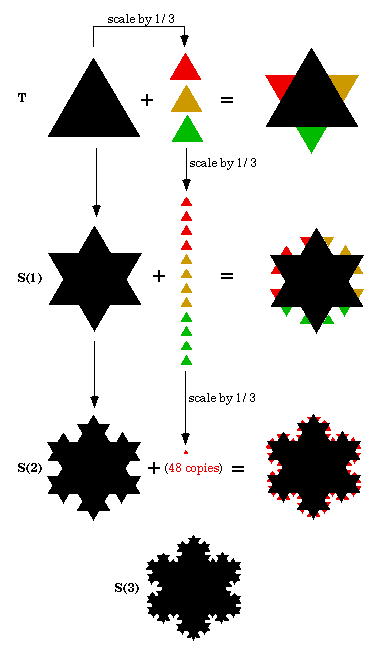
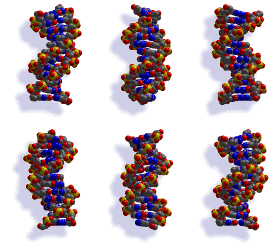


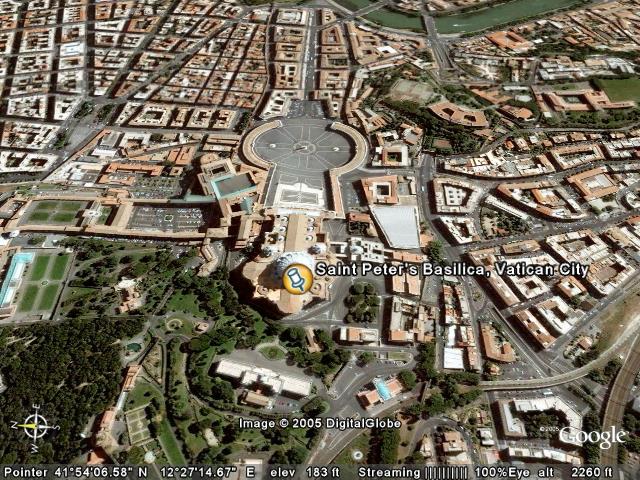

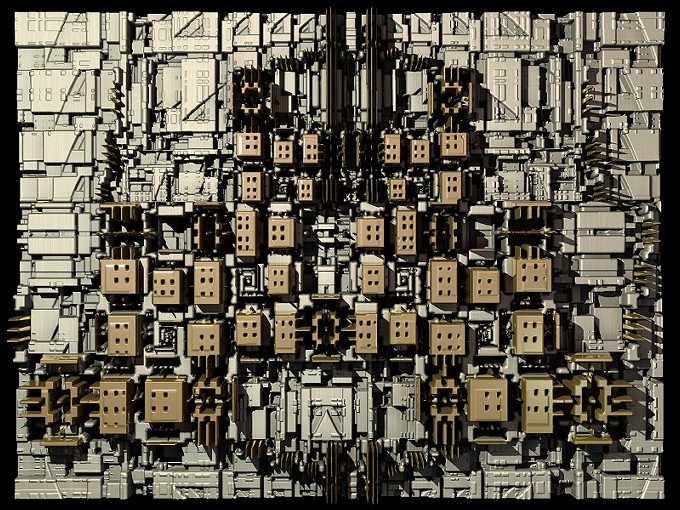


 حسن ستاری ساربانقلی


